Pot-scraper
Friday 16th
January 2022

|
|
The Week Before Christmas
Pot-scraper |
|
|
|
I woke up in the middle of the night feeling the cold. I moaned the fact the heating didn't appear to be running over overnight, then put on my thermal socks and fell back asleep. At 7am we both got up. I pulled back the curtains and it was still pitch black out there. It was a little difficult to motivate ourselves. Even the day itself hadn't woken up yet. Usually we would have stayed in bed but we had a South Iceland Circuit tour booked so we had to get up. We had some coffee and toast to help. I also had a "fruit and nut" skyr (yogurt, which was a really interesting flavour combination.
It was just after 8am when we left our apartment. It was getting colder. The weather app was showing -10C. When we walked down Laugavegur street we came to a running track painted on its tarmac. "On your marks, Get set ..." I joked. Julie's sense of humour hadn't woken up yet either.
We reached the pick up point at bus stop #6, opposite the Culture House. The place was busy with people. It was a popular stop for several tour companies.
We were ten minutes early for our pick-up so we walked up the hill to take a closer look at the statue of Ingólfur Arnarson. He may not have been the first European to step foot on Iceland but folklore tells the story of his arrival and how he decided on this bay to establish his settlement. I took my gloves off to take a photograph and my fingers instantly froze. There was an icy wind whipping in from the East. There was a lot of activity at the bus stop. It was impossible to know which minibus was ours. Thankfully someone came around calling out our names.
We boarded our bus, which was washed in a neon light. It reminded me of the "boogie bus", a free transport a local nightclub layed on for its discerning clientelle. Not that we ever used it. We set off, half full, but we called at three other pick up points on the way out of the city, filling up the 20 seater minibus. The driver and guide introduced himself as Devon. He had a soft American accent and a great dry sense of humour. He constantly talked, keeping us informed and entertained as we headed South East on route 1, aka Hringvegur, the main ring road that cirlcled the entire country.
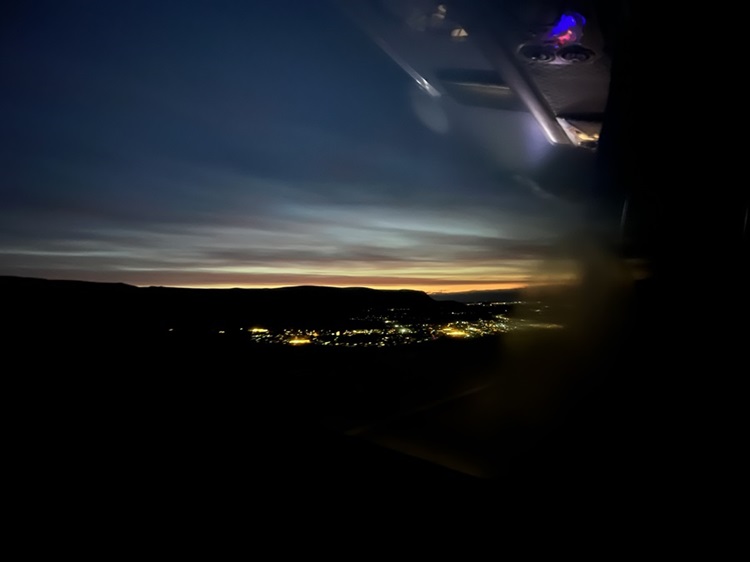
It was still dark outside so there was nothing to see. The first thing of note we saw, or almost saw, was billowing steam at the Hellisheidi Thermal Energy Power Station that provided the electricity to Reykjavik. The temperature was getting even colder. A roadside information sign told us that it was -12C out there. Inside Julie was struggling to contain her coughing, resulting in a tension headache. She was still unwell. After about an hour of darkness a hint of a sunrise appeared in the distance.
Soon afterwards we crossed the Ölfusá river, over a suspension bridge, into the town of Selfoss. Devon mentioned the town had two museums, one called Skyrland about the Icelandic yogurt Skyr, the other was called Fischersetur honouring an American chess player called Bobby Fischer who lived in Iceland for three years before his death in 2008. He became famous for winning the 1972 World Chess Championship against Russian Boris Spassky. It was held in Reykjavik. Devon went into quite some detail about him. He disappeared from public view, becoming a recluse only to emerge twenty years later in a rematch against Spassky, held in Belgrade, Yugoslavia. He beat his opponent again, winning a $3.5 million prize money. As a result he broke an UN embargo set against any commercial activity involving Yugoslavia because of the conflict in the Balkans. A warrant for his arrest was issued which effectively made him a fugutive from the United States. In 2005 he sought asylum in Iceland, became an Icelandic citizen, and renounced his American citizenship. Devon was surprised that no one had ever heard of him before.
We continued South East along route 1. Devon pointed out Volcano Hekla in the distance. "I take hiking groups up there, if anyone's interested" he announced. He also pointed out Eyjafjallajökull, the volcano that brought the world's avaiation to a standstill when it violently erupted in 2010.
About two hours after leaving bus top #6 we arrived in the town of Hvolsvöllur where we pulled over at a service station for a comfort break. We noticed for that it had snowed here, which wasn't the case in Reykjavik.
He mentioned the Icelandic love of liquorice in their chocolate and a particular favourite of his was Þristur, pronounced "Thristur". As it's name suggests (thri something) it has three parts, a soft but chewy caramel, a mild hint of liquorice and coated in a milk chocolate. Of course we had to buy one to try. I'm not the biggest fan of liquorice but this was OK. In fact more I ate, the more I liked it. There was something addictive about it. We also bought another chocolate called Xtra Prins. This was wafer-based and liquorice free, similar to a KitKat but not as nice. It's a derivative of the Prince Polo (a chocolate bar from Poland) which for a long time was the only chocolate you could buy in Iceland.
Another delicacy Devon mentioned, but we didn't feel the urge to buy was Harðfiskur, dried fish snacks. I suppose they were no different to pork crackling only made from fish and not pig.
After we all used the facilities and stocked up on snacks, we returned to the minibus to continue our journey. Only ten minutes down the road we stopped again when Devon noticed a herd of Icelandic horses. We pulled over and went to have a closer look. They were short and sturdy, and had their thick winter coats, not too disimilar to the Welsh Mountain Pony. Their bloodline is considered pure since the time of the early settlers when there would have been cross breeding from various horses and ponies. An interesting fact about them is they naturally have extra gaits, or different styles of movement. A regular horse would have a walk, trot, canter and gallop. An Icelandic horse has two more, called a tölt which is inbetween a trot and canter. It looks really odd, a bit like an Olympic walker, always on the verge of running. Then they have flugskeið (flying pace), a similar movement to the tölt but done at high speed, where the back is straight and the legs are all a flurry, some reaching 30 mph! It's the only breed of horse in Iceland. There's a ban on importing horses. Even if an Icelandic horse is exported, it is not permitted to return. The strict rules are in place to safeguard the herds from imported diseases.
Back in the minibus we continued our journey driving past the Seljalandsfoss, one of the waterfalls on our itinerary, but we didn't stop. Devon explained that he was aiming to be back here before the sunset. "There's a path that goes behind the waterfall where you can get some great photos" he explained "escpecially during that time of the day."
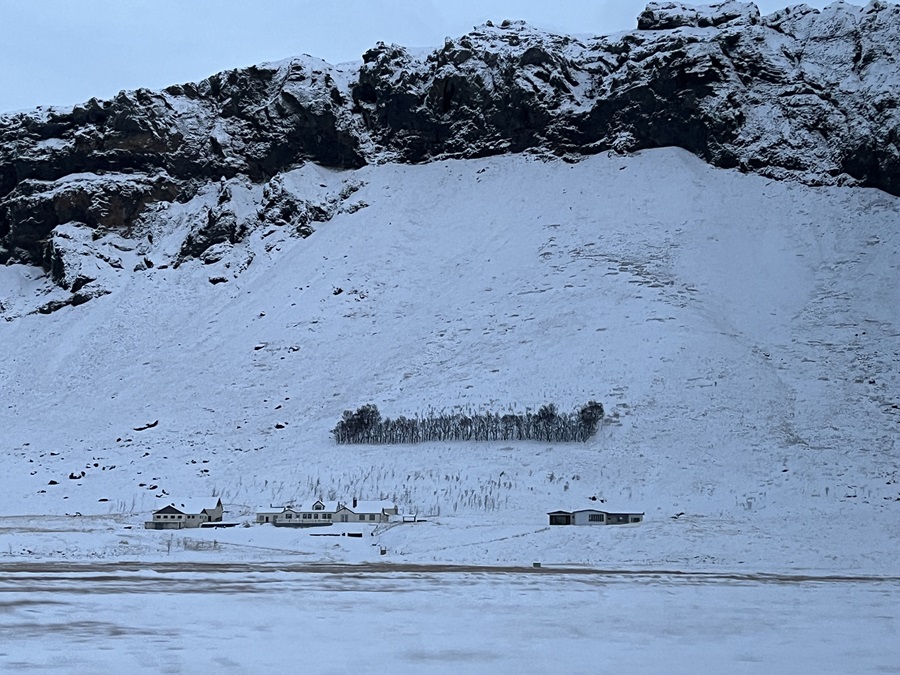
Route 1 now ran between the South coastline to our right and the dark looming cliffs of the Eyjafjöll mountain range to our left. We past a farmstead which appeared to have a row of trees planted to protect it from an avalanche or landslide. It was a dramatic scene. Devon pointed out islands out in the sea called Vestmannaeyjar or the Westman Islands. It literally meant the island of the men from the West, which for the Norse meant the Gaelic people of Britain and Ireland. There's a legend written in the Book of Settlements, that the brother of Ingólfur Arnarson, the founder of Reykjavik, was murdered by a Celtic slave. In his rage he hunted him down to the Westman Islands where he was captured and killed in revenge. On a lighter note, he mentioned that the Westman Islands are probably the best place to see Puffins in Iceland.
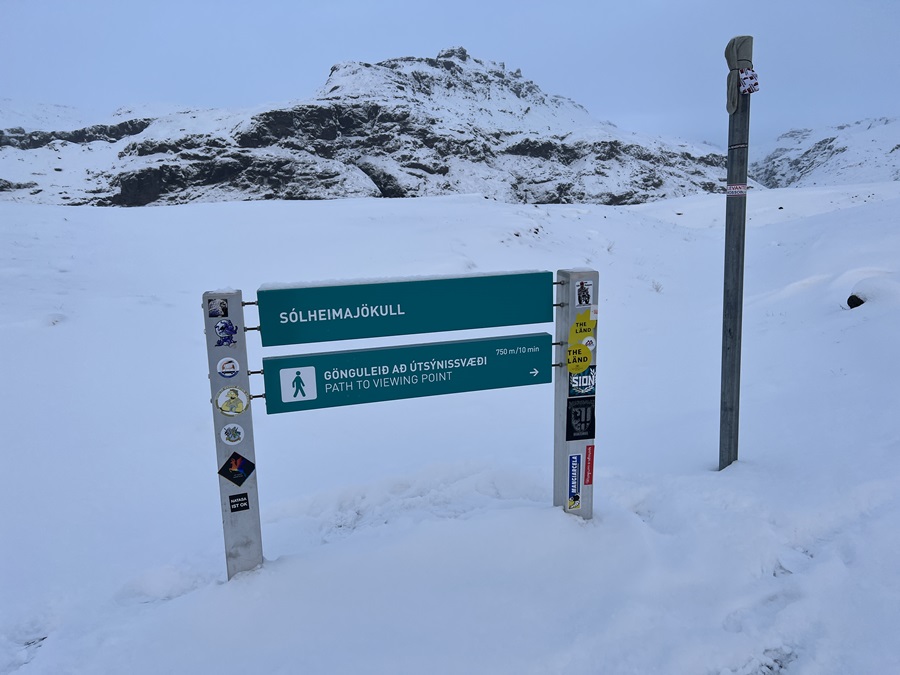
Almost half an hour later we turned off the ring road and headed inland towards the Sólheimajökull glacier. We didn't have to travel far to reach the car park but the rest of the way was on foot. Devon offered the use of crampons for those who wanted them. We felt we could do without them. He explained that because of climate change the glacier had receeded considerably. Only a few years ago it was almost at the car park but now it took us about 10 minutes to walk the kilometre to reach a designated viewing point. The glacier was formed between the Eyjafjöll and Katla volcano mountan ranges.
Despite the sub-zero conditions it was actually a nice fresh day for a short walk. The path had been covered by fresh snowfall overnight. We were literally following in the footpaths of others to reach the viewpoint. We noticed our faces were bright red through the exposure to the cold and the exertion of trudging through the thick layer of snow.
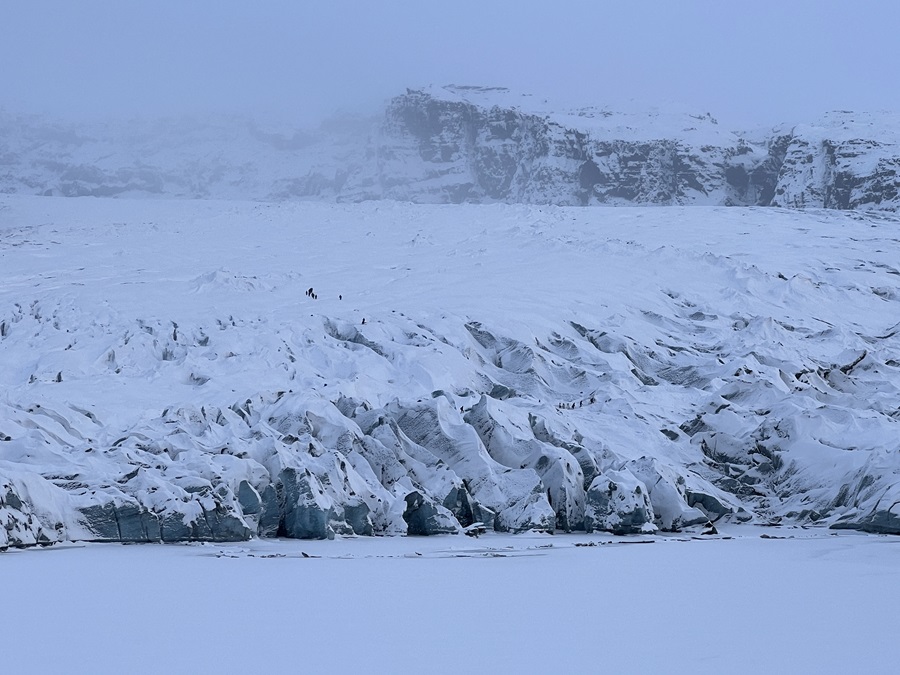
We turned out attention to the glacier. The view over a frozen lagoon towards the ice ridges and cliffs was impressive. It wasn't the first glacier we had ever seen but it was definitely the best example. Looking closer we could see the cool blue of the exposed ice at its edge. It was difficult at first to judge the size of the glacier but there were a few groups of people walking on it, appearing as small dots. This gave us the perspective of its scale. It was mountainous.
Our path continued beyond the viewpoint, towards the glacier. "We're not going there, are we?" asked Julie. That's when a group with all the gear passed us, all kitted out with hard hats, crampons, sticks, on their way to scale the glacier. Such a hike wasn't for the faint hearted. With the melting ice, slippery crevices and deep sink holes were common place. It's sad and scary to think that they estimate in the next 50 years there may not be any glacial ice in Iceland. I hope that's an exaggeration. After about quarter of an hour admiring the stunning landscape we returned to the car park.
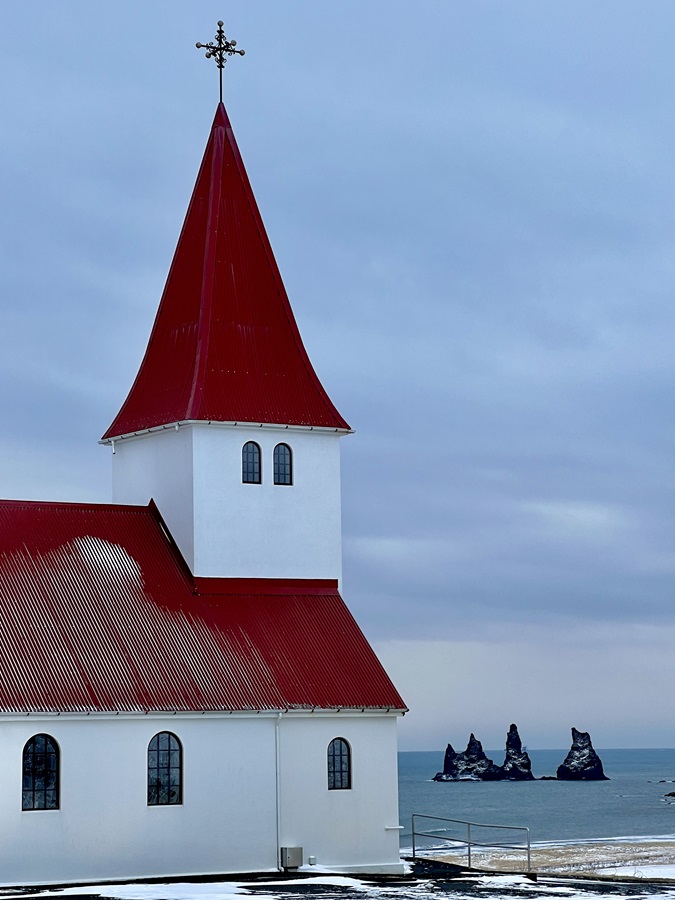
A few minutes down the road we came to Vik or Vík í Mýrdal, to give its full name. It is Iceland's most Southern settlement. It's most significant feature was the Vikurkirkja Church standing high above the village. Vik was the actual location featured in the Netflix drama Katla. It is predicted (factually not just fictionally) that one day the massive Katla volcano will erupt with devastating consequences. It has been dormant since 1918 and is due let off some steam. You must be a little insane to want to live in such a place.
They used to say that the entire population of Vik could shelter in the church in the event of an eruption but I don't think that still holds true today. It would get a bit cramped if all 600+ inhabitants gathered here all at once! When Katla blows they predict a flash flood rushing down the mountain, submerging the village. Being the highest point in Vik it still forms part of the emergency planning. People often practice running up the hill to reach its sanctuary. Helicopters would then be sent to rescue the survivors. Devon pointed out the old people's retirement home. "I think it was put there because it wouldn't be far to wheel the residents up here!" he remarked.
From the door of the church there was a fabulous view. We could see several rock pillars, two hundred feet tall reminants of the Reynisfjell mountain that jutted out into the sea. Known as the Reynisdrangar folklore recalls the story of trolls turned to stone by the break of dawn. Some say they were dragging a three-mast ship back to shore when the sunlight got them, others say they kidnapped a young woman from a nearby farmstead and were chased out to sea. Being mountain dwellers not sea creatures they were stuck out there until they were frozen by the sunlight. It's interesting how most cultures have "turned to stone" legends but in Iceland there's definitely a stronger connection to their folklore. In 2006 a survey asked people to "consider the existence" of the huldufólk (hidden people, like elves and trolls). It was broken down into three categories, álfar (elves), fylgja (followers - ghosts who attach themselves to an individual) and álagablettir (spell-spots - places where elves either live or are sacred to them) The result was astonishing. 32% admitted to believing that there was a possibility that the huldufólk were real, 16% thought it was more than likely and 8% were absolutely certain. That meant 56% did not dismiss the existence of the hidden people. That rose to 63% for spell-spots and 70% for the followers. I don't know how much of it was all tongue-in-cheek with the famous quirky Icelandic sense of humour but either way it way a wonderful reflection of their character.
The church itself was very traditional, modest white-washed walls with a striking red roof. It was built in 1934 and designed by Guðjón Samúelsson the same architect responsible for the Hallgrimskirkja church in Reykjavik. We didn't stay long, just enough time to take a few photos. This was as far East as we were travelling. When we got back in the minibus we returned towards Reykjavik. However, it wasn't the end of our adventure, we still had a couple of more things too see. The first of which was the black volcanic sand beach at Reynisfjara.
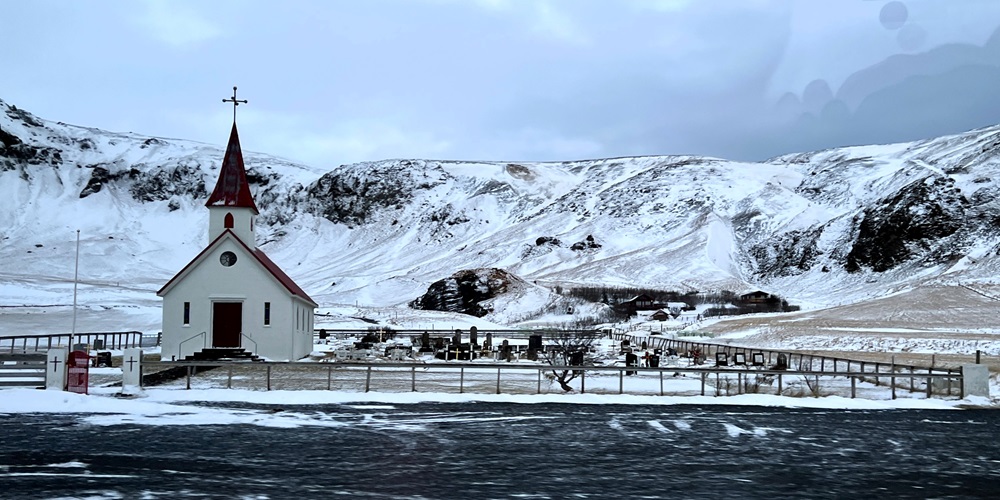
Along the way, after we turned off route 1 heading towards the beach, we past another traditional church, Reyniskirkja. It looked identical to the church in Vik with white walls and red roof. This one, built in 1946, looked very quaint with its gate and perimiter fence. What struck us was its remoteness, there wasn't another house in miles!
As we approached the beach Devon talked about the treachourous sea phenomenon that occurs at Reynisfjara, called "sneaker waves". They suddenly appear without warning, surging further up the beach, and dragging back anyone in its path with its powerful undertow. Several people have died in recent years. They introduced a warning system of red, amber and green hazard levels to inform tourists of the potential risk. They had the advice "Never turn your back to the ocean" Today it was flashing amber, a medium hazard day, advising us not to enter the yellow zone. Although we didn't know where that was? We proceeded with caution.
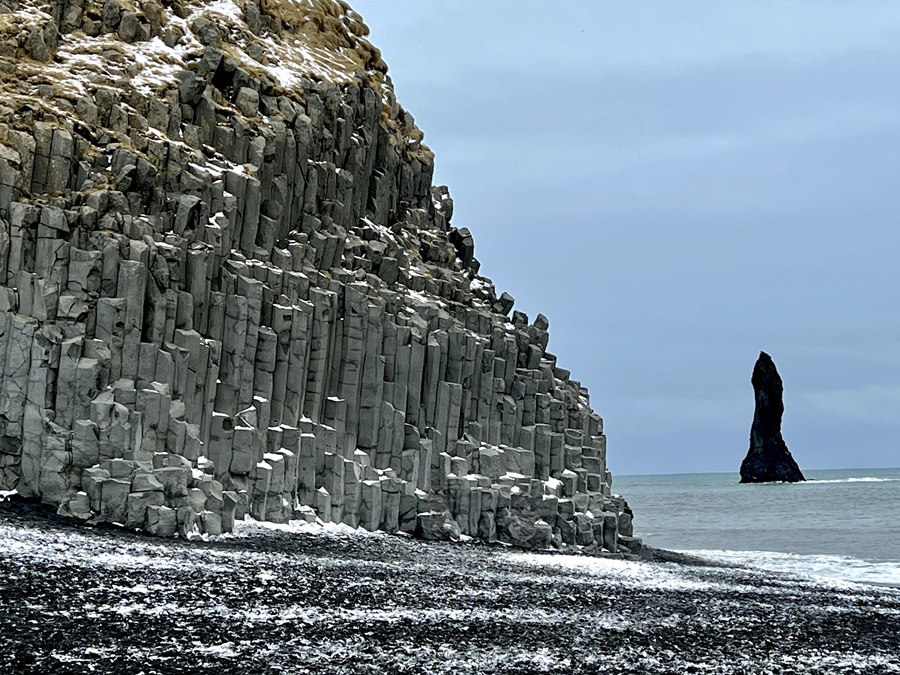
We headed straight for the cliffs of the Reynisfjall mountain. The hexagonal basalt columns were a geological wonder, formed by the cracking of cooling lava. They looked strange, unnatural even but undoubtedly magnificent. "There's a place in the East of Iceland I'd love to see" I said to Julie, referring to a canyon of basalt columns. Right there and then we hatched a plan to return during the summer months. "I'd love to see the puffins" added Julie.
We continued around the corner, hugging the cliff face. Julie was a little worried of getting too close to the shoreline. If ever there was a yellow zone it would have been this stretch of beach, close to the cliffs. A sneaker wave would have wiped out all those who were walking along it. A little further out into the sea we could see the Reynisdrangar, the petrified trolls. We didn't walk any further, turning instead to walk back along the beach, a safe distance away from the shoreline.
The Reynisfjara's black volcanic sand stretched for almost two miles West towards Dyrhólaey with its rock arch jutting out into the ocean. It was also Iceland's geographical Southern-most point. An interesting fact was that there was no land mass South of here until you reached Antartica! There was a strong icy cold wind. After hardly 10 minutes walking around the beach we decided to return to the car park and grab some lunch at the cafe.
The Black Sands restaurant was more than your usual car park cafe. It was a modern steel and glass cabin, but more importantly it was really nice and warm inside. They had a small menu but some decent choices for us both. We could have had soups, salads, burgers, or fish and chips. Devon had recommended the rófusúpa a local turnip soup but was I hungrier than just a soupful, so I went for their spinach pesto pasta dish, with cherry tomatoes which was delicious.
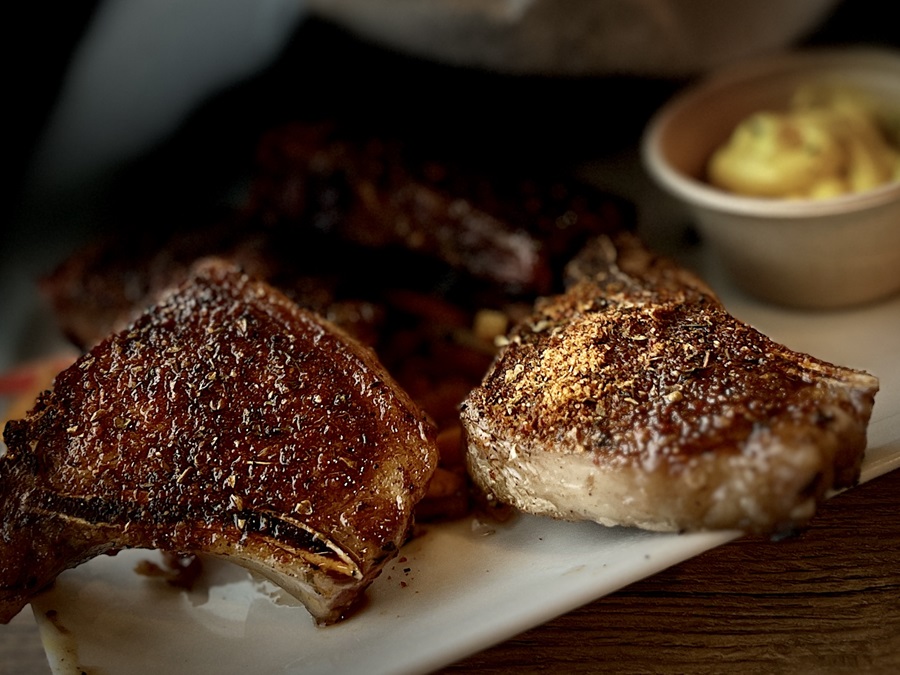
Julie had the lamb chops, which came with roasted veg, a Bearnaise sauce and fries. She thoroughly enjoyed them. "I wasn't expecting this trip to be such a foodie destination!" she said.
With time to spare before we were all due back at the minibus I headed to the cake counter where I was spoilt for choice. One in particular was screaming out at me, not because it was labelled "VEGAN" but because of it was chocoalte and salted caramel. It was just perfect with a cup of coffee. Before we left we both sensibly headed to the toilets for a squeeze. When we met back in the cafe we fell about laughing because we both used the wrong gender toilets. For my part, I was surprised how nice the toilets were, and did wonder where the urinals were but the penny didn't drop until Julie noticed the urinals on the way outof the gents toilets! Back in the minibus we set off to our next point of interest on our itinerary.
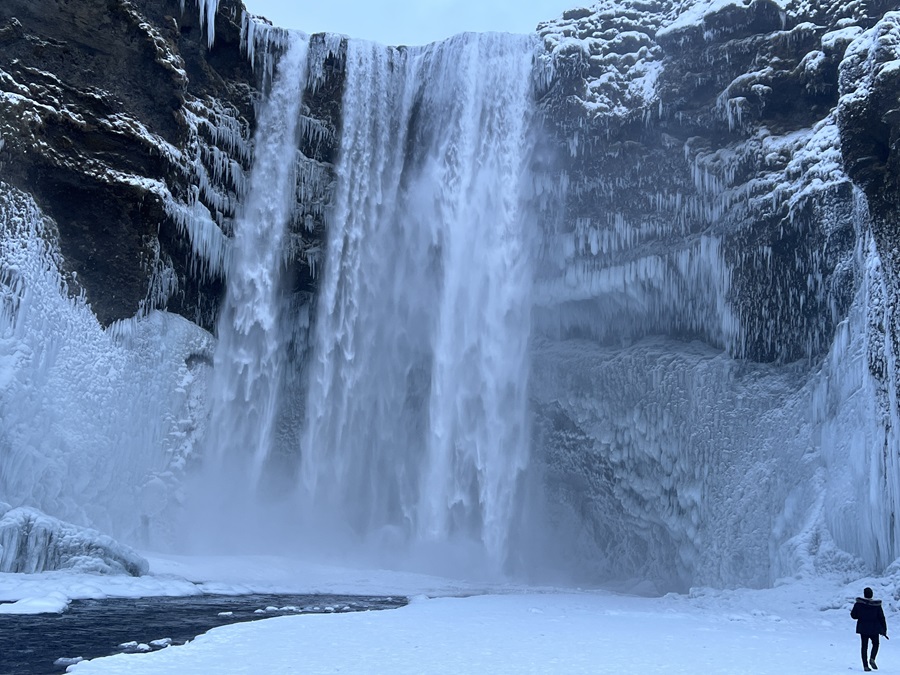
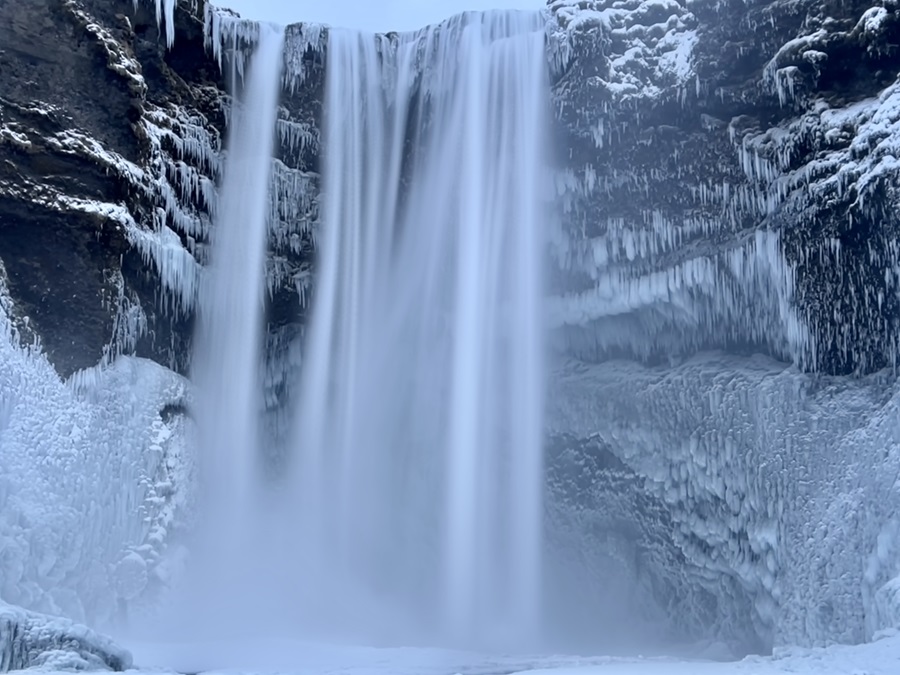
The Skógafoss waterfall was around half an hour's drive away. When we arrived, our jaws dropped. We could see it from the ring road as we pulled up at the car park. It looked so dramatic, especially with the snow and ice. We walked the short distance towards it in absolute amazement.
The Skóga river flowed over the cliff edge, dropping 60m with thunderous effect. It was a powerful force. Apparently there was a viewpoint, 500 steps up on the side of the cliff. "You can go if you want" said Julie but I couldn't imagine the view was any better than standing at right at the foot of the waterfall.
We walked to the edge of the river that flowed away from the base. "Stay away from the edge!" Julie warned. For once I agreed. That water looked incredibly cold! It was surprising how close we could get. It was only the spray that kept us from getting any closer.
It was stunning, not only the waterfall but the frozen cliff wall created a magical scene. We stood there admiring the natural beauty for as long as we could before we began to feel a little damp and cold. We retreated, slowly making our way back to the minibus, stopping often, for just one more look.
From Skógafoss we travelled a further half an hour until we reached Seljalandfoss, the other popular waterfall on the South Circuit tour. We saw it earlier this morning but didn't stop because the itinerary was scheduled to visit during the sunset hours.
It wasn't as impressive as Skógafoss. Despite the drop being the same, the volume was a lot less. Devon reckoned it was reduced by over two thirds of it's usual flow. Of course its not all about the size and what Seljalandfoss could still offer was the unique experience of walking behind the waterfall, seeing rainbows appear in its spray as the sun sets behind it. It was now just after 4pm, and whilst there was still some daylight it looked like we had missed the golden happy hour. However, as it happened, it didn't make any difference. The path to be behind the waterfall was closed, we assumed for safety concerns. "Well, at least we have another reason to return" said Julie.
We walked around, crossing the river, to admire the water fall from all conceivable angles possible before heading back to the car park, having seen enough.
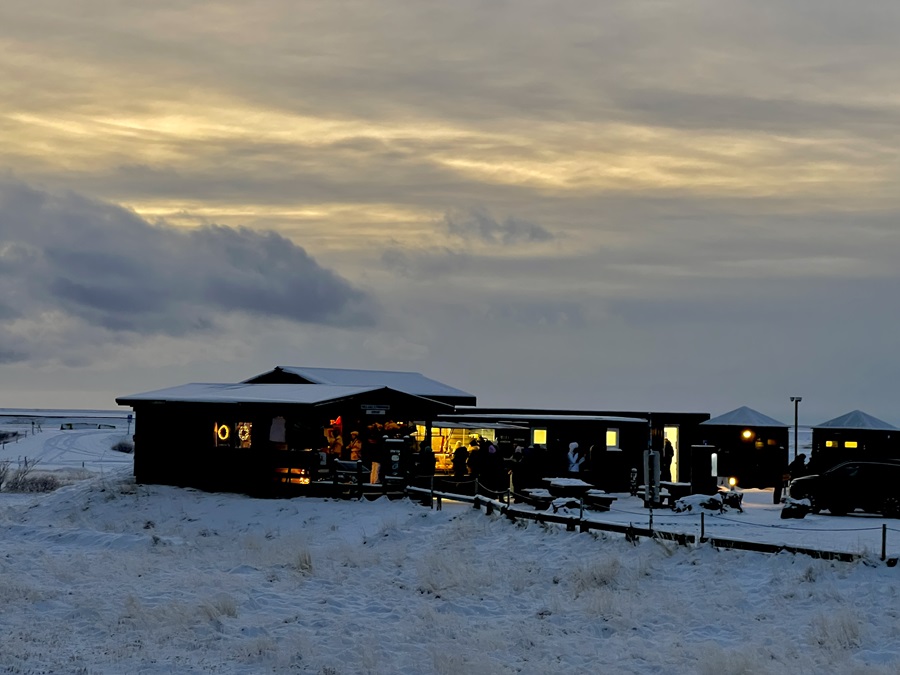
We were the first to return to the minibus so we had a look inside the small store in the corner of the car park.
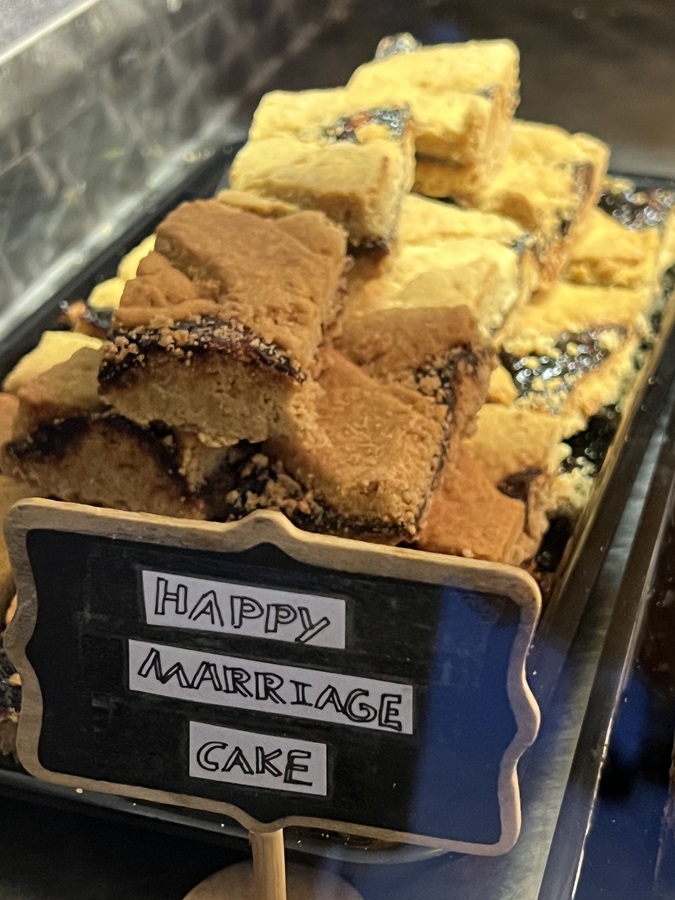
They had on sale a traditional Icelandic cake called Hjónabandssaela, or Happy Marriage Cake! It was an Icelandic rhubarb crumble. I'm not sure of this was the best example because it was mostly crumble with a rhubarb jam filling. It was just starting to get dark as we all piled back into our minibus and made our way back to Reykjavik. A few miles down the road and it was pitch black outside. We tried to get some sleep on the way back, if only to expand our day-span a little later into the night. It took us almost two hours to return to bus stop #6 where we began this morning. We had about an hour in our apartment before it was time to head out again. No time to rest, just a quick costume change. We had a dinner reservation at the Reykjavik Kitchen for 8:30pm. It was now snowing heavily. We had been watching it come down from the comfort of our living room for the past half hour. The groud was already thickly covered as we shuffled all the way up Laugavegur street. The restautrant was a good ten minutes walk away.
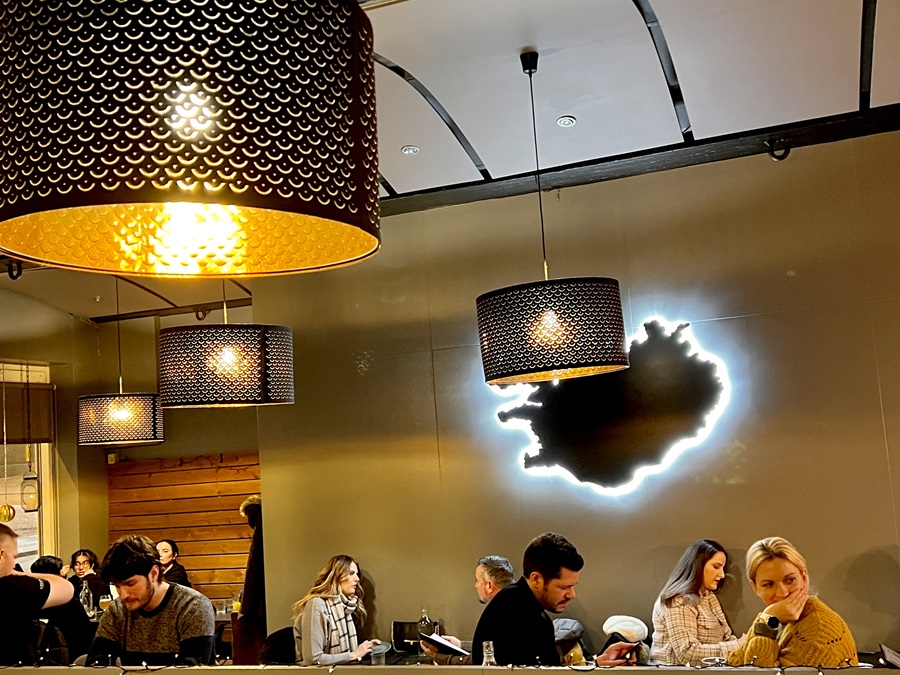
We arrived on time, shook off all the snow in the doorway and were shown to our table. The menu was interesting with plenty of choices. We decided to skip starters and dived straight into the main course.
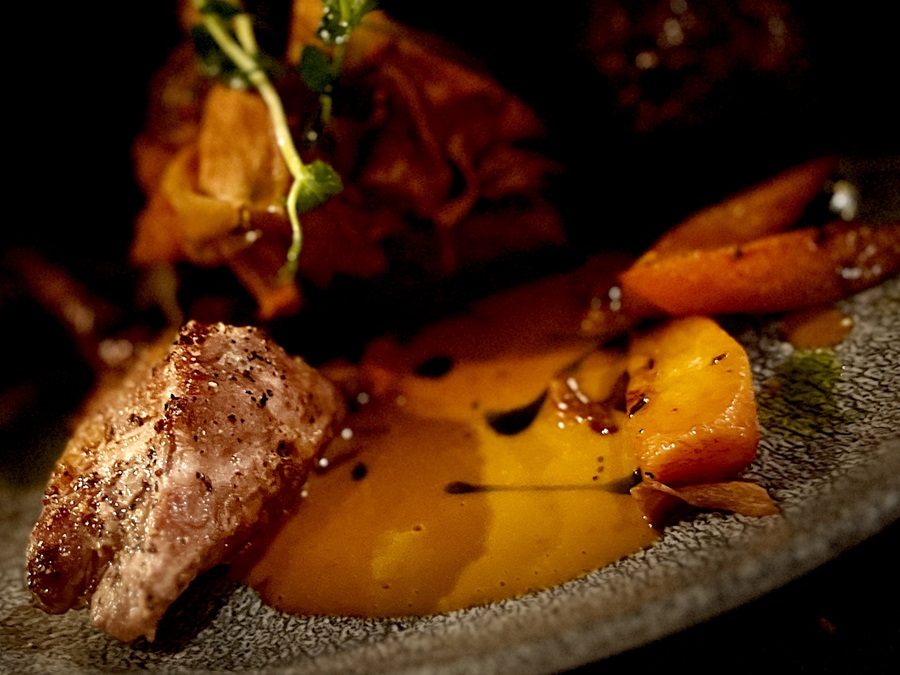
Julie went for some more lamb, this time it was shank, served with carrots, red cabbage and despite the sweet potato puree she absolutely loved it, declaring it the "best yet".
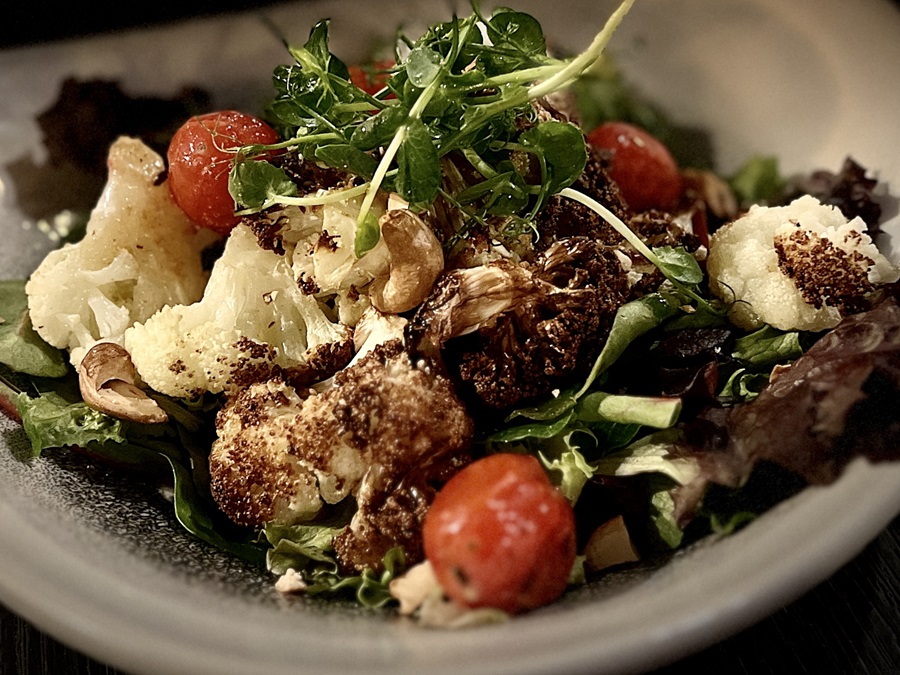
The roasted cauliflower served as a warm salad tickled my fancy and it hit the spot with an incredible amount of flavour from the charred florets and perfectly balanced dressing. It exceeded my expectations.
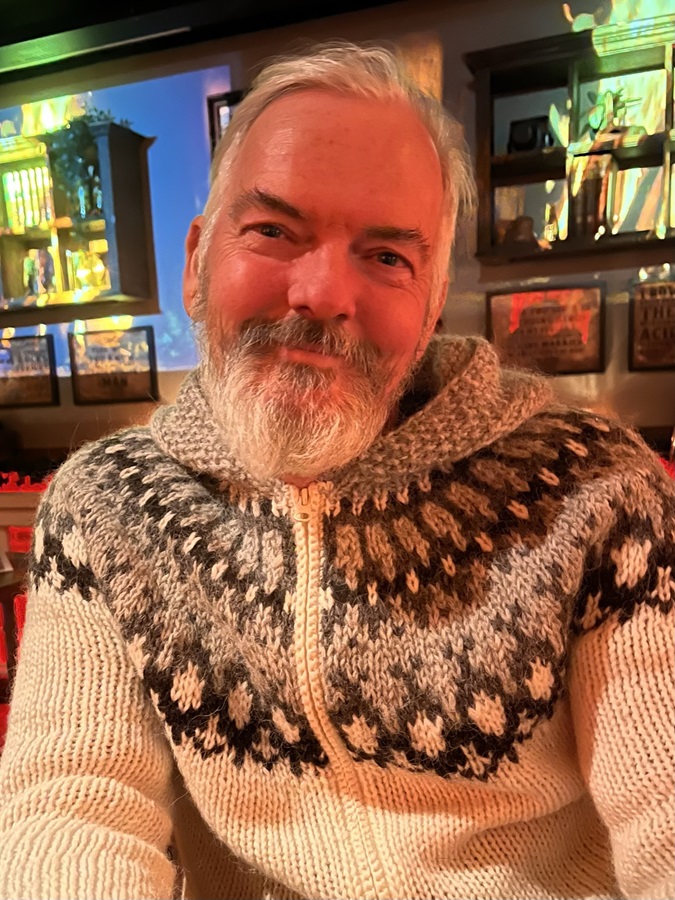
We weren't going to have a dessert until a specials menu came around with an "Only in December" offering of "Mum's rhubarb cake". It was another Hjónabandssaela, a happy marriage cake making a reappearance! This one was more restaurant quality served with a vanilla ice cream, chopped hazelnuts, caramel drizzle a shard of white chocolate and a Christmas infused rhubarb compote. It was divine. Sat at the table next to us was this old couple. The gentleman was 84, he told us himself. He was from Athens, Georgia, USA. He was telling us about his wife, how she began her career with NBC television broadcaster becoming the first female something? Sadly neither Julie and I understood what he said and were too polite to ask him to repeat himself. I don't know if he said news anchor which would have meant she was Barbara Walters, quite a big deal in her heyday. He said he worked years for the American Institue setting up their education campuses all over the world. They were such an interesting couple. We got talking when the lady complimented me on my new cardigan. She was wearing a garish Norwegian style sweater and I just couldn't bring myself to return the compliment.
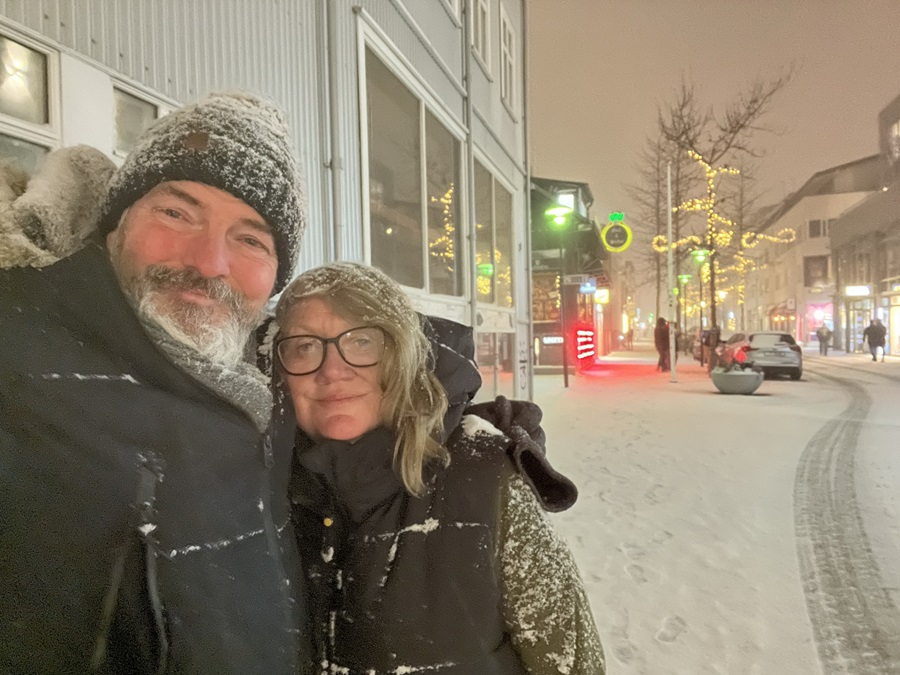
We left the restaurant at 10pm, braving the elements on our way back down the hill, towards When we posted our selfie on Facebook Julie's Auntie Brenda rightly asked "Where's your hat?"
Before retiring for the night we stopped for a round of drinks at the Lebowski bar. It was cosy inside, decorated like a log cabin with a warm glow of a fire. We had no plans for tomorrow morning so we were scheduled for a late night but at 3000kr (£18) per round the miser in me struggled to buy another.
We slowly sipped our drinks before quietly leaving the bar to the young revellers. Returning to our apartment just after 11pm. Next Day >>> |
|
©Copyright 2000 - 2026 Colin Owen |