Kiss the Bones
Saturday 20th
May 2017
|
|
The Full Monty
Kiss the Bones |
|
|
|
Our plans for an early start went out the window when we didn't wake up until 8am. Of all the days to have slept-in! Julie skipped breakfast, mostly because the only food available was last night's left overs. She had the right idea. I had some microwaved Popara and it certainly wasn't as nice this morning.
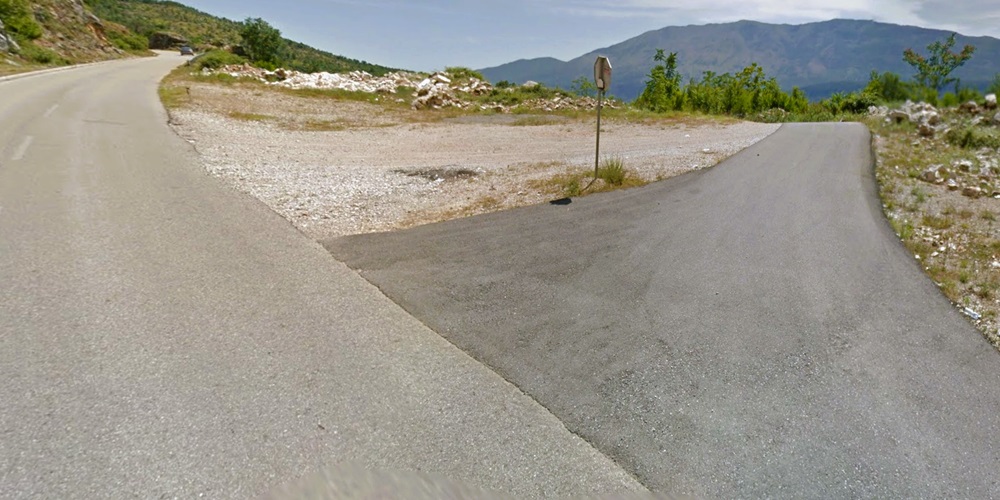
We handed our keys to Milan, who handed over his business card, in case we ever wanted to return, then we could book direct with him next time. We were going to miss our little apartment. We felt so comfortable and at home in Perast. We wheeled our suitcase to the car and set our Sat Nav for Ostrog. The first stop was a petrol station in Risan where we filled the tank. The Sat Nav then decided to send us off the main road, past the Roman Mosaics and up the hillside towards the mountains. When we came to a junction, the SatNav wanted us to turn right, continuing beyond where the tarmac stopped and a concrete track began. Our exact words, blurted out in unison, was "fuck that". It may have been a short-cut to where we were going, but there was no need for it.
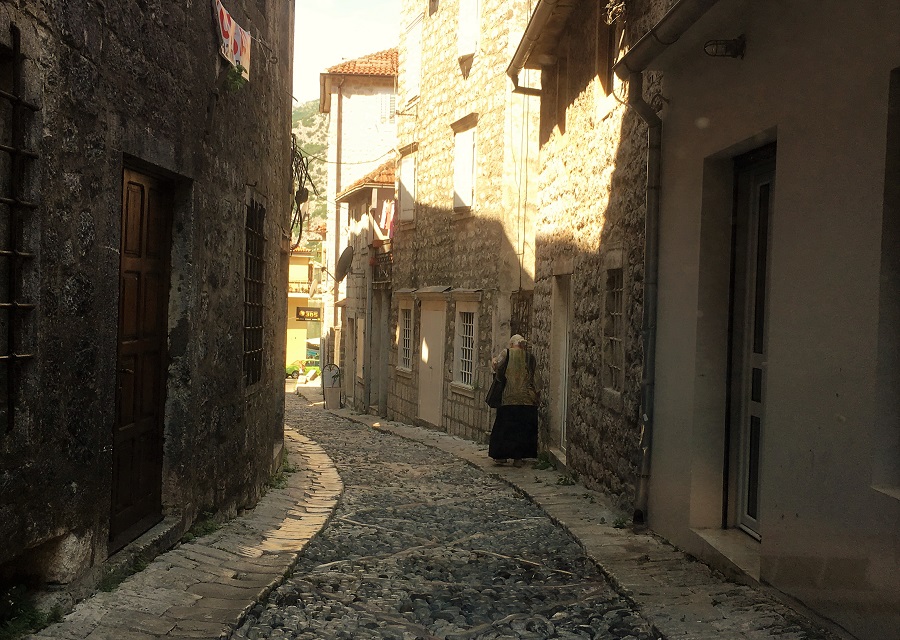
We decided to ignore the mindless directions and turned left, back down the hill towards the bay. The road got narrower and narrower as we drove down the quaint cobblestone street of Ulica Gabela. It was like we were travelling back in time, certainly to a time before cars. Despite only driving a little VW Polo it seemed too narrow. An elderly lady stepped out of her house and began walking down the street. I couldn't pass her. So we rolled down the hill at elderly woman walking pace, keeping a safe distance behind her. Eventually we reached the end of the street, popping out next to the Post Office.
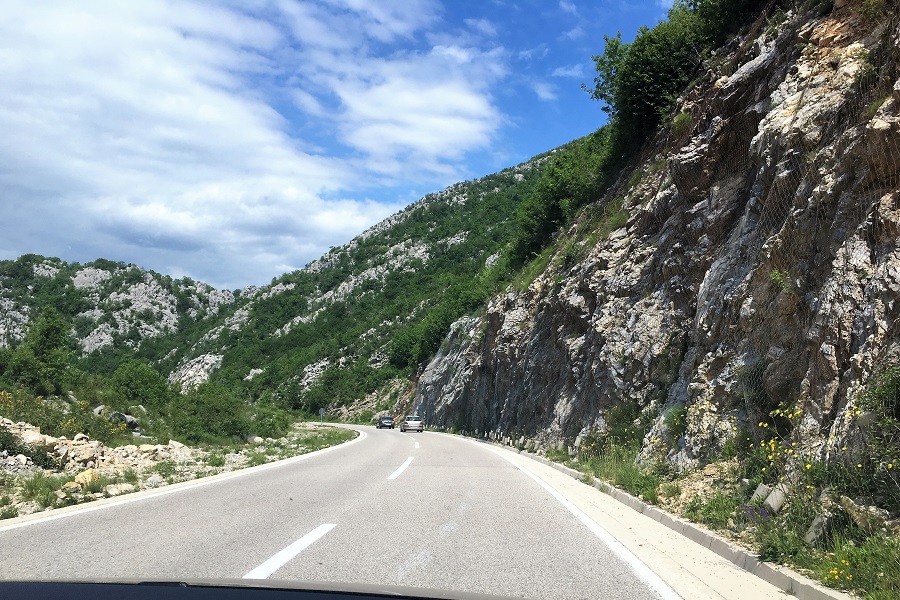
Back on the road again we got a move on, driving along the bay to Lipci where we joined the P11 highway. It cut through the mountains, rising quickly into the highlands. The scenery was incredibly rocky covered with hardy shrubs. To call the landscape rugged would have been an understatement.
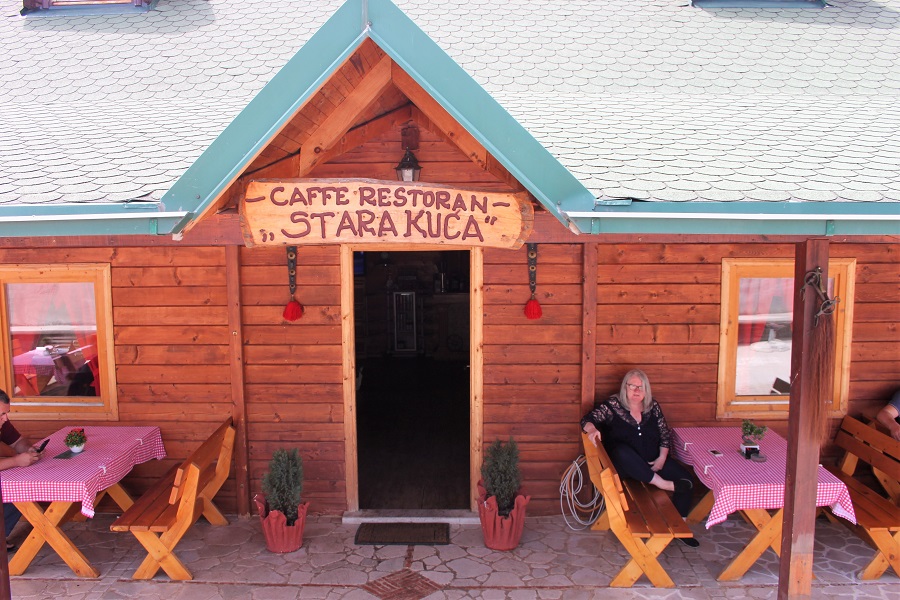
Half an hour later, and only twenty miles further down the road, we decided to have a pit stop and pulled over at a roadside cafe called Caffe Restoran Stara Kuća. It seemed in the middle of nowhere but apparently 3 miles away was a small village with a lake called Grahovac. The cafe was built to look like a log cabin. The strong smell of pine was still fresh inside so we sat outside. Julie hadn't eaten breakfast so she was hoping for something to eat. She asked if they did croissant or any sort of pastries. "No" was the abrupt answer. No further explanation, just "No" We both felt in need of a coffee, so Julie had an americano, and I had a cappuccino but they weren't great. It tasted like filter coffee and the frothy coffee was mostly froth.
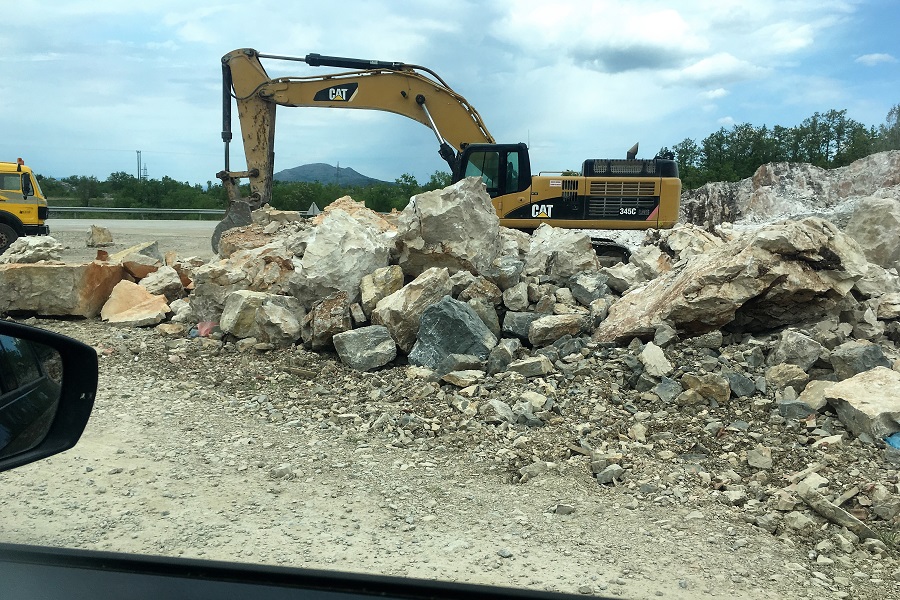
Julie left hungry, resorting to some crisps we had in the boot of the car. We returned to the road and continued North until the road came to an end. They were literally still building it! Our way forward seemed blocked off by a pile of boulders. Right at the end we noticed a track that allowed us to continue. For about half a mile we carefully drove through a construction site until we came to a junction with the M6 road. Three miles to the West was the Bosnian border. We turned Eastwards.
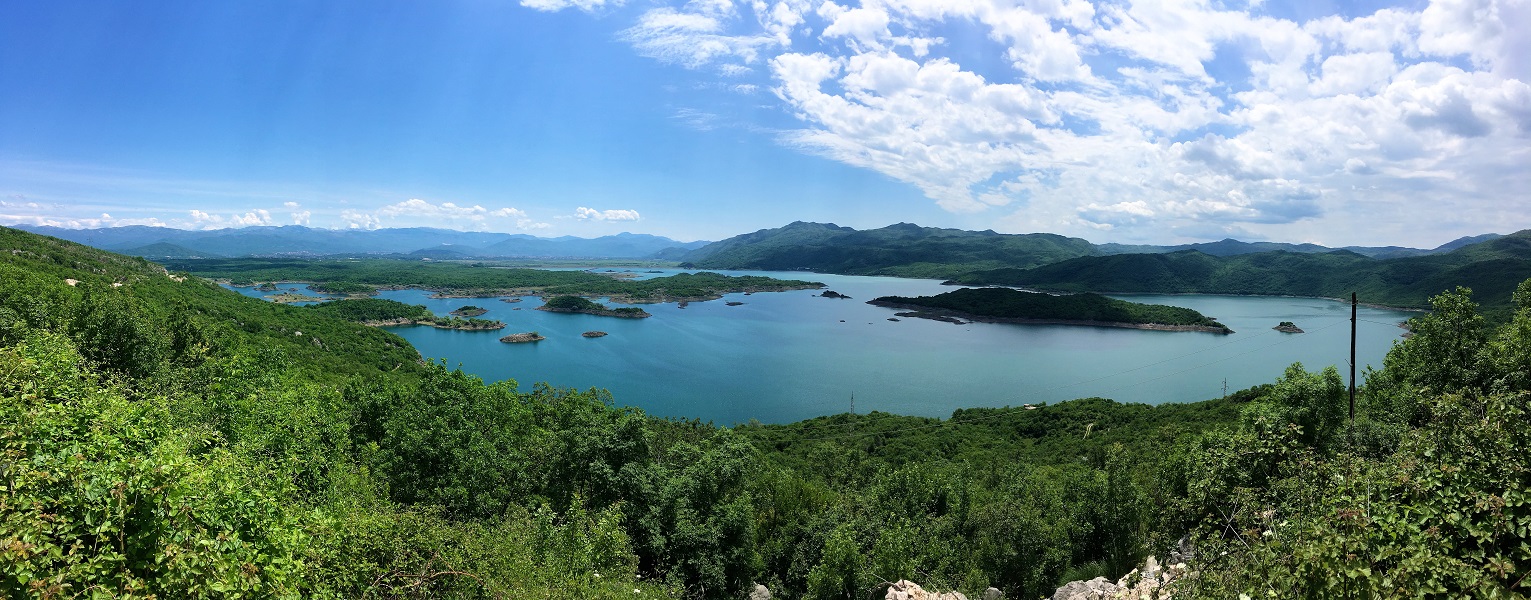
The scenery soon changed, less rugged more lush, as we came to a lovely view over Slano lake. It was so nice I pulled over at the first avaiable corner so we could take some time to admire it. Eventhough Slansko jezero was artificially created in 1950 to feed a hydro-electric plant it's "natural" beauty was undeniable. As we continued our journey, coming down hill to the village of Kuside I saw a pair of policeman waving a little paddle, no larger than a ping-pong bat. I guessed he was pulling me over, so I did as I was told. He asked me for my "papers". I retrieved my passport, driving license and Europcar rental agreement for them to check. I thought I had been caught speeding but thankfully nothing came of it. They got a call over the radio and seemed in a rush to leave. They returned my doucments and quickly drove off.
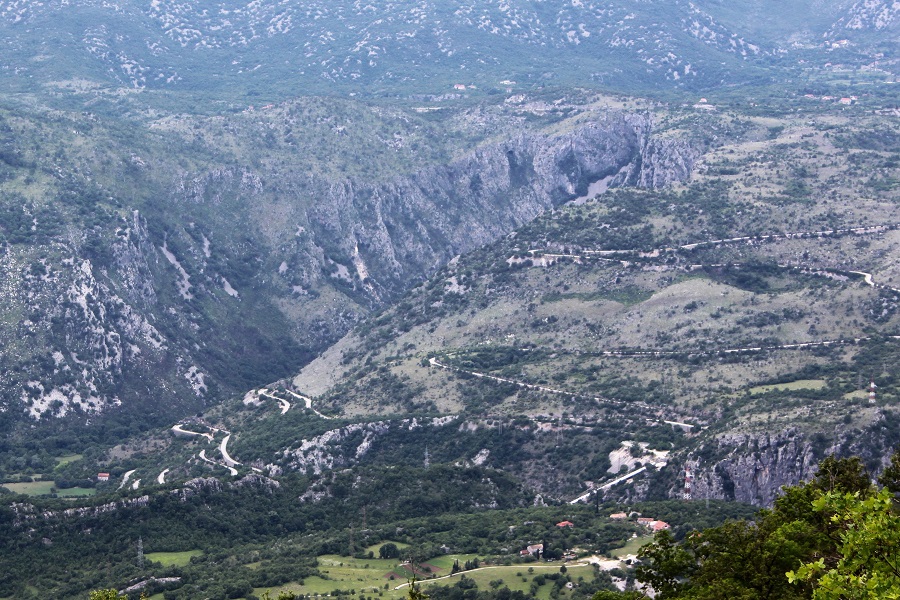
After reaching Niksic, Montenegro's second largest city, we drove back South through a long tunnel and out into the Bjelopavlići plains, a valley where the landscape returned to being rugged. At the village of Bogetići we turn off the main road and onto a narrow road that meandered up into the hills.
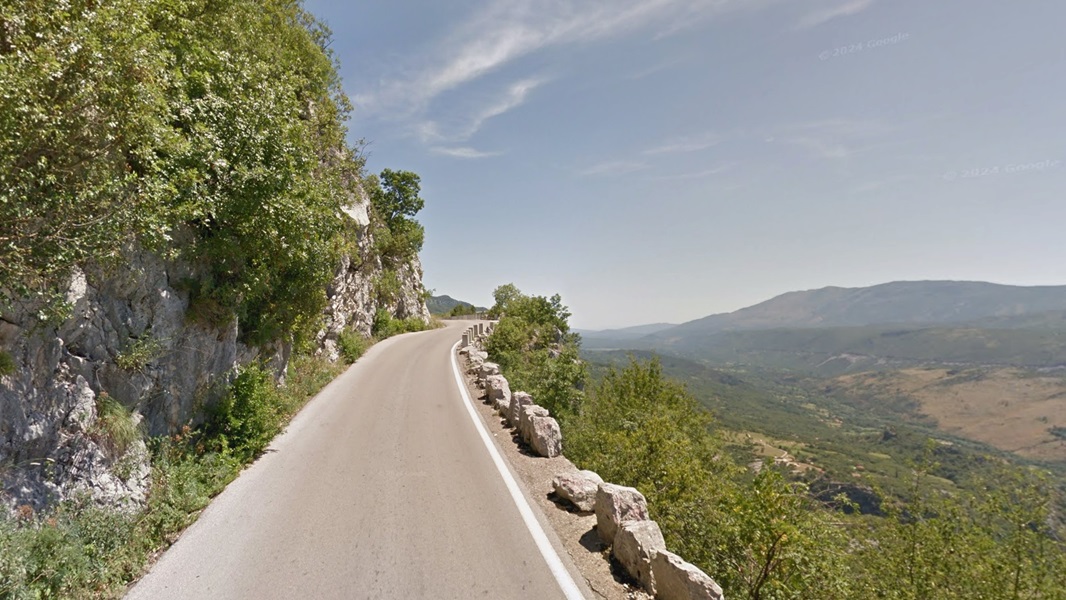
The road got so narrow it felt like it was only wide enough for one car. What made it worse was the drop to our right. Julie was besides herself with fear, especially as she was sat right on the edge. She was praying we didn't meet another car. But we did, three times. I pulled in as far as I dared, slowing down to a stop to allow them the space to squeeze past. By the time we reached the village of Povija we were both pretty traumatised. Fortunately from there on the road wasn't as precarious. When we reached a cluster of coaches near to a few restaurants and the Lower Ostrog Monastery, we both wondered "how the hell" did they get there! The road from the other direction must be much wider. However, our journey wasn't at an end. We turned off the road, snaking up steeply towards the Upper Ostrog Monastery. It was another thrill ride that Julie didn't appreciate. There was one point, and it had to be the narrowest point, we met a car coming down. There was a rock jutting out in the tarmac further complicating matters. The car was edging its way past us. I pulled over as far as I could. I couldn't move any further to the right. Cars behind us were beeping their horns. We were right on the edge. This was the moment Julie thought she was going to die. She was literally quivering. Eventually the car squeezed past, which allowed us to move more to the middle of the road and past the protruding rock. Other obstacles we had to overcome were all the pilgrims. We had to be careful not to hit them as they seemed oblivious to the fact they were walking in the middle of a road.
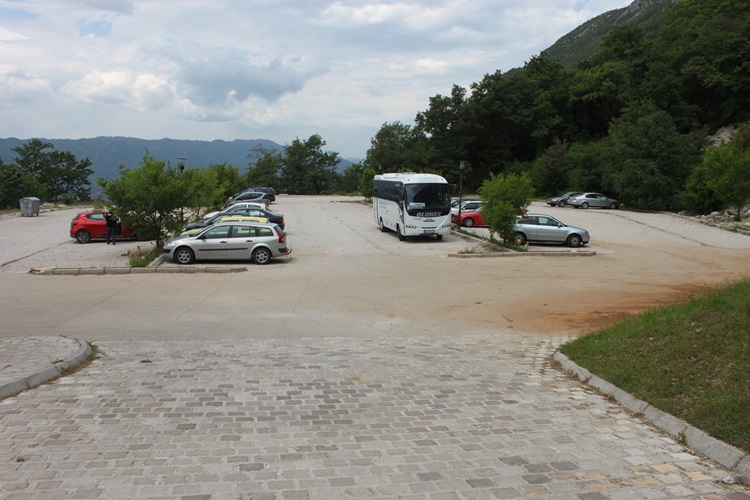
The final ascent, a sharp turn to the right, was close, a barrier stopped any traffic and was only opened on requests. But the road continued straight on up and opened out into a large car park. There were plenty of empty spaces. When I pulled the handbreak and took the keys from the ignition we both let out a huge sigh of relief. We had arrived unscathed. There was a bus parked. We couldn't believe it! How was it possible? Did they drive it up that road?
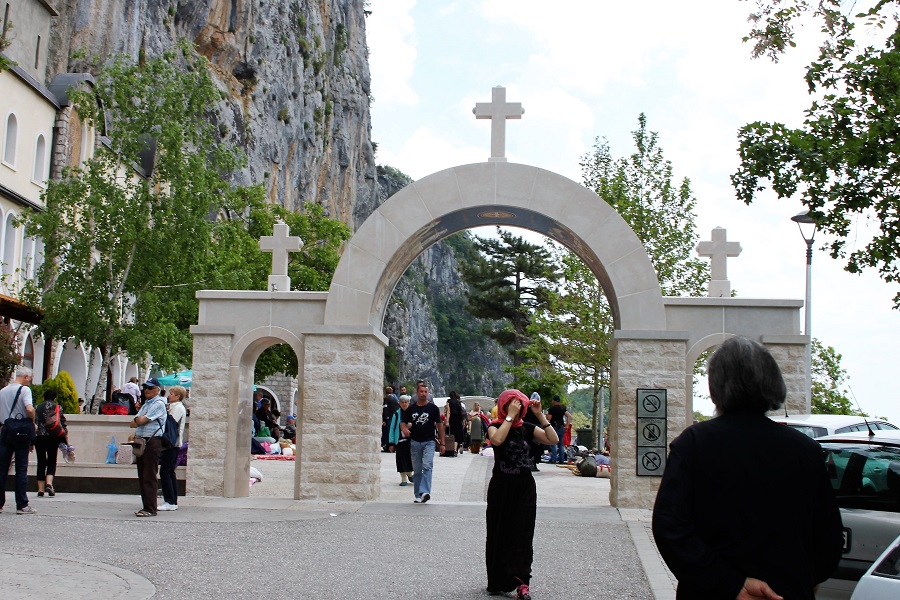
Steps lead from the car park up to join the last bend of the approach road. It took us ten minutes to walk up to the entrance arch of the Ostrog Monastery. We were surprised how busy it was.
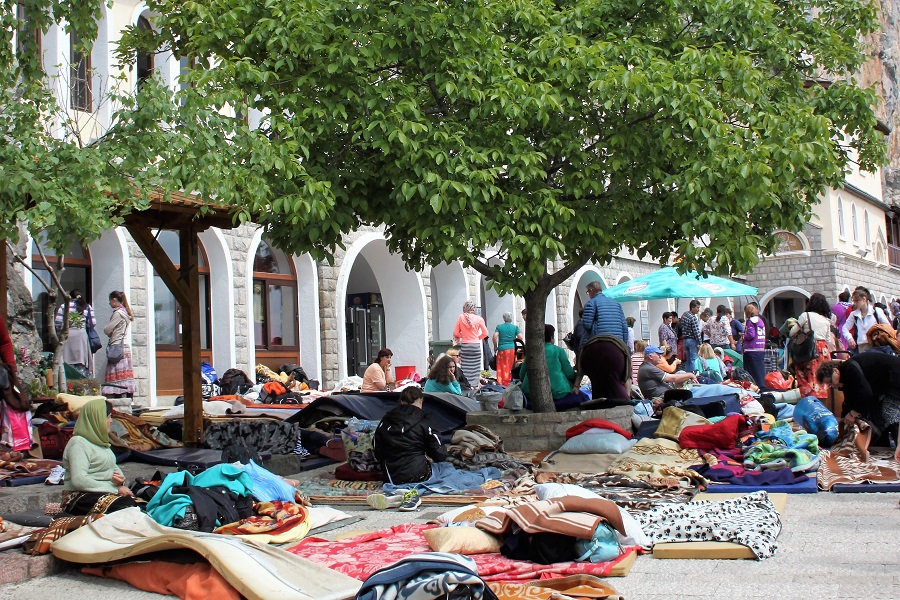
The courtyard was crowded with mattresses and sleeping bags where pilgrims had clearly been sleeping outside overnight. I don't know if we had arrived on an auspicious day or was this normal every day occurence for the monastery. The feast day of St. Basil of Ostrog, its patron saint, was celebrated on the 12th May, so it wasn't anything to do with that. So it must have been a regular Saturday crowd.
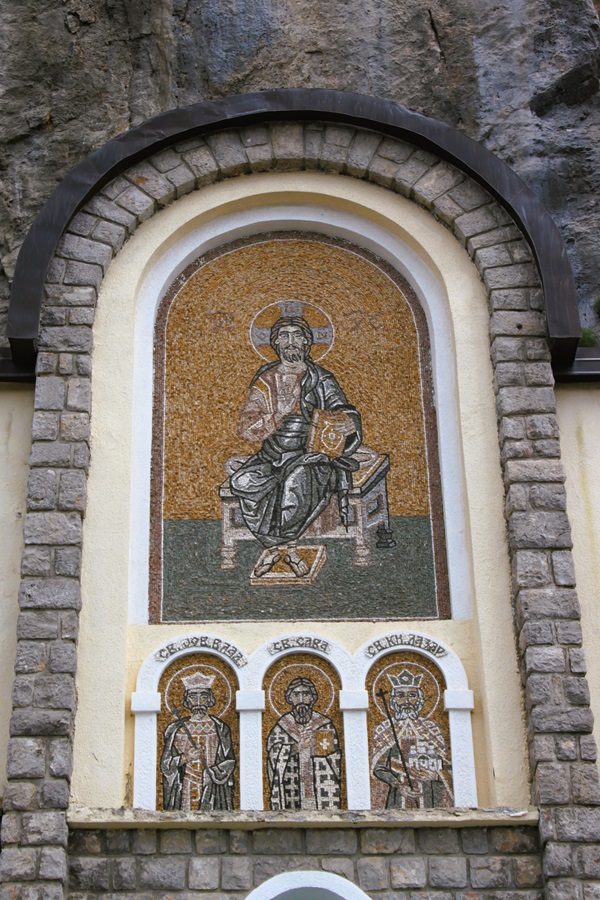
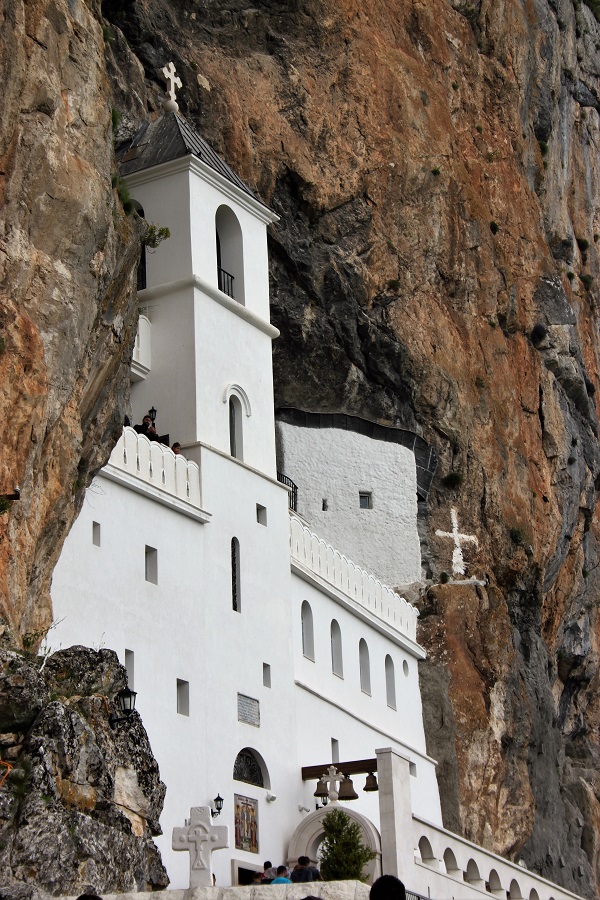
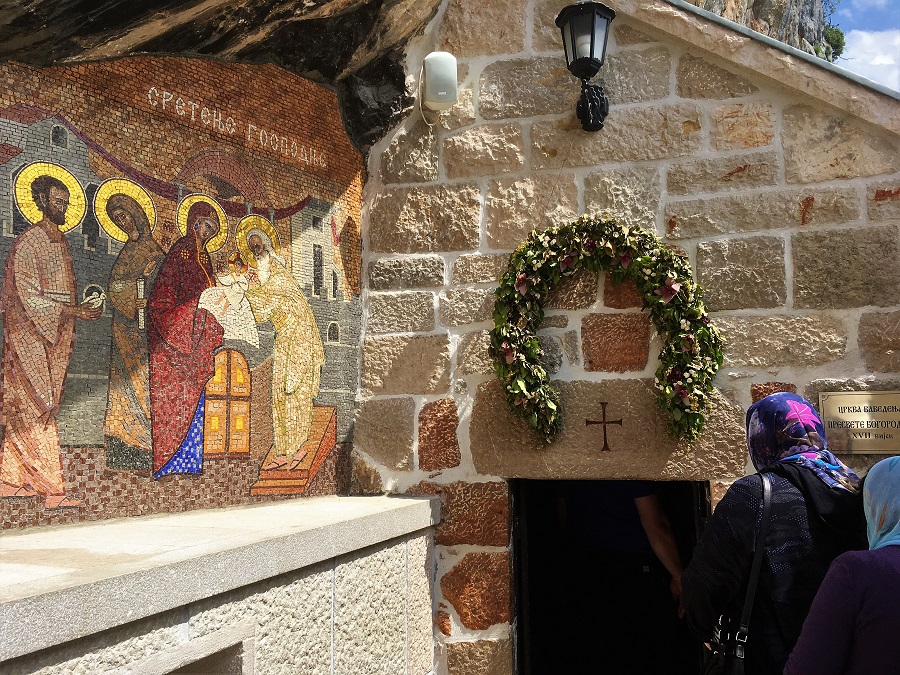
In the courtyard, cut into the rock of the cliff face was the monks' residence and administative building. It wasn't a plain austere structure. Instead it looked like a church itself, with three large arches filled with mosaics of saints. Most of what we see today, even the main monastery, only dates back to 1926. A major fire destroyed much of the complex and it had to be rebuilt.
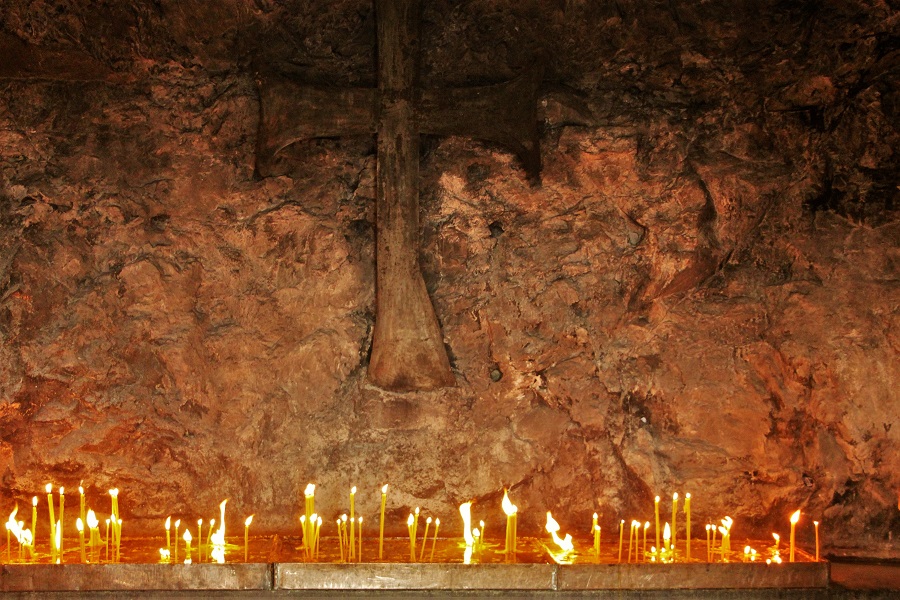
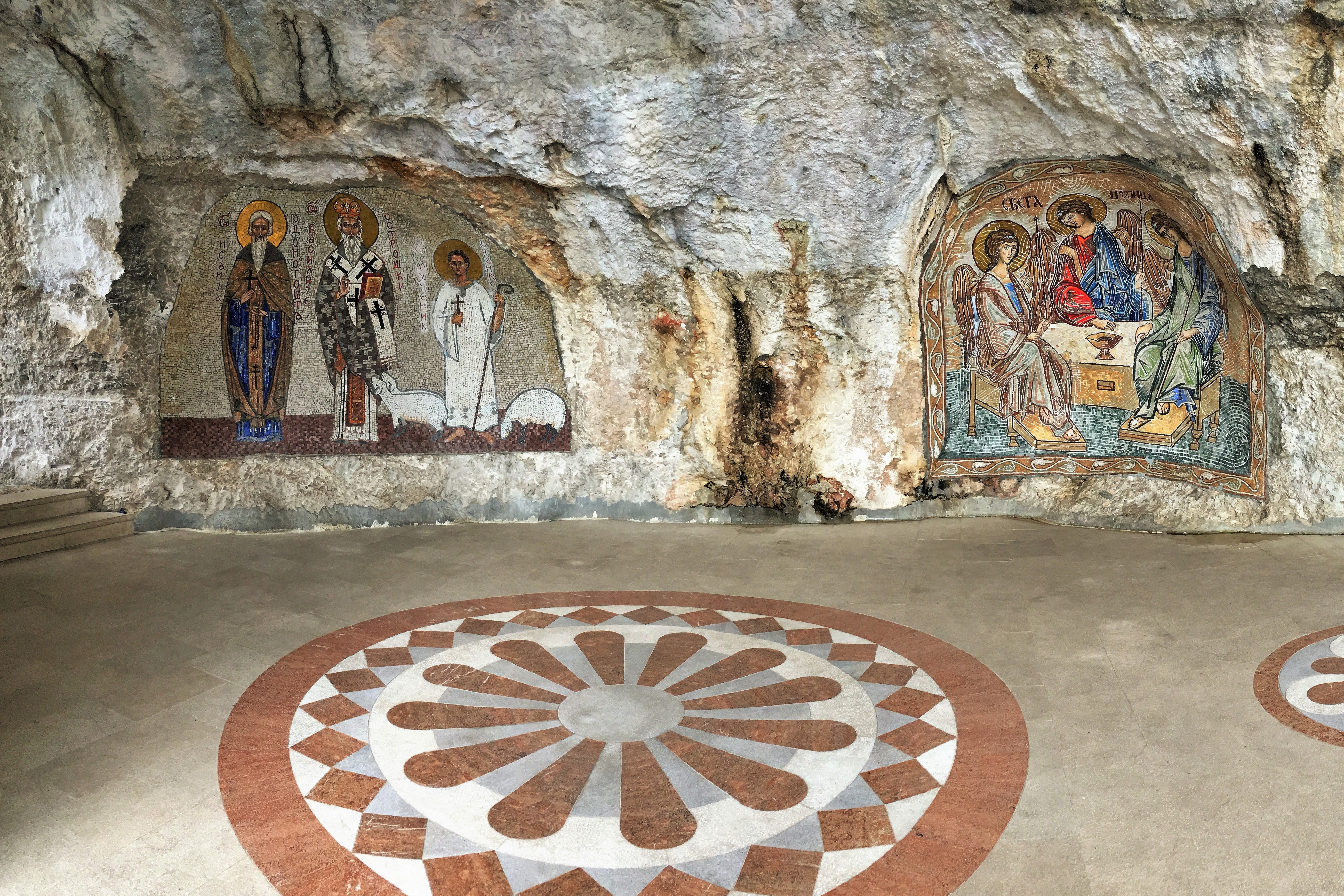
Just to the side of it was a cave cut into the rock. It was incredible atmospheric. I suppose it was a church. Inside there was a wooden cross mounted on the wall, and a tray of candles. What more do you need? A hermit known as Saint Isaiah had already established a church in a cave here when St. Basil of Ostrog arrived, around 1640 and chose this location for his monastic retreat.
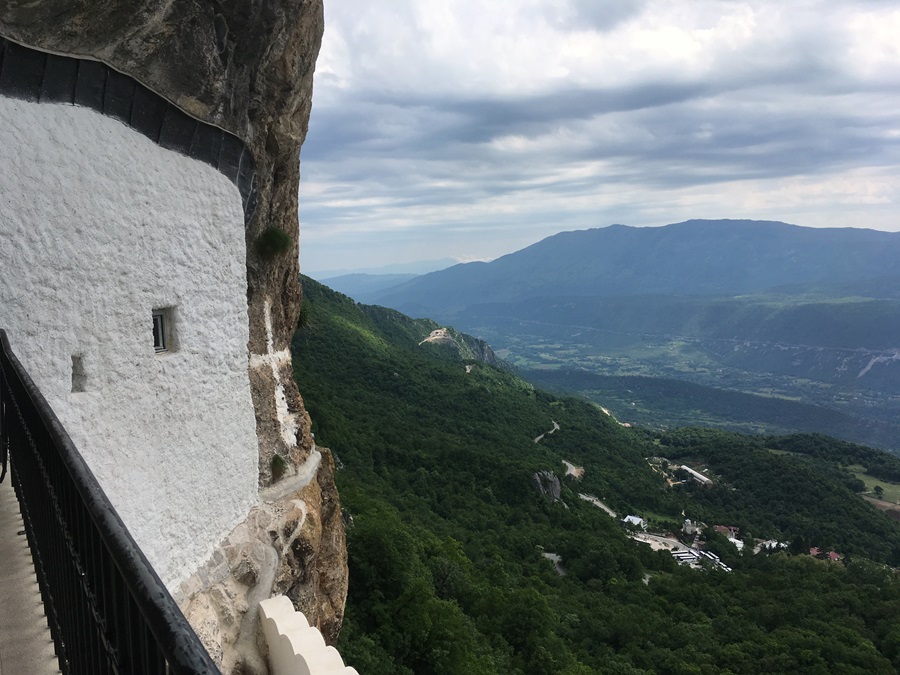
Further along the cliff was the white washed monastery, ingeniously built into a crevice in the sheer rockface of Ostroška Greda mountain. Wanting to have a closer look we joined the back of a very long queue. It's very unlike us. The first sign of a queue and we usually lose interest. "Having come all this way we're not leaving without seeing what's inside" said Julie.
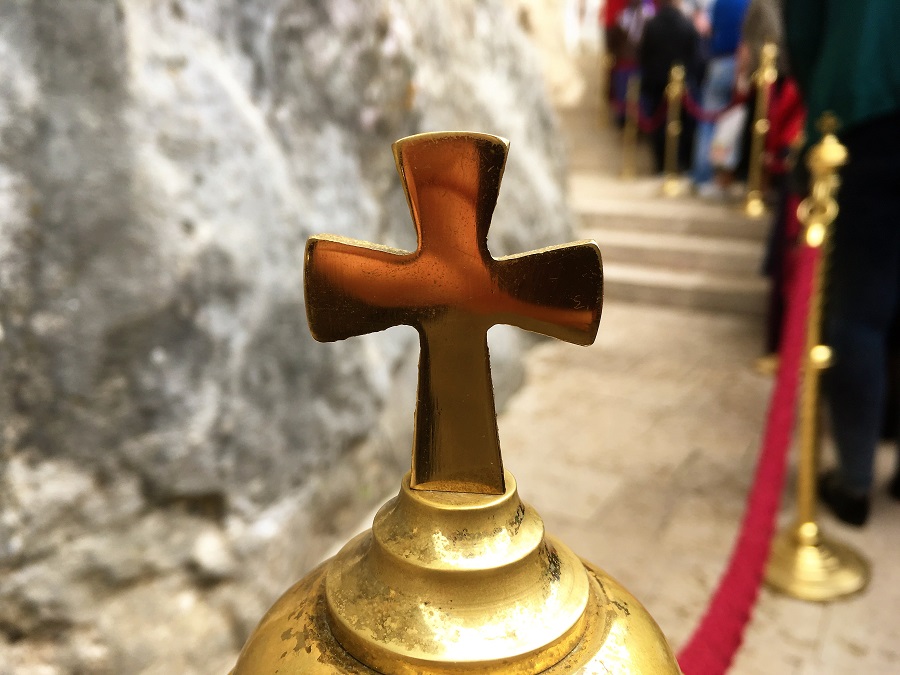
We shuffled along slowly, getting closer to the monastery, step by step, then actually shuffling past it. Our path was restricted by a cordon that kept us all in line. We had now comitted to seeing it through, despite having no idea of what lay ahead.
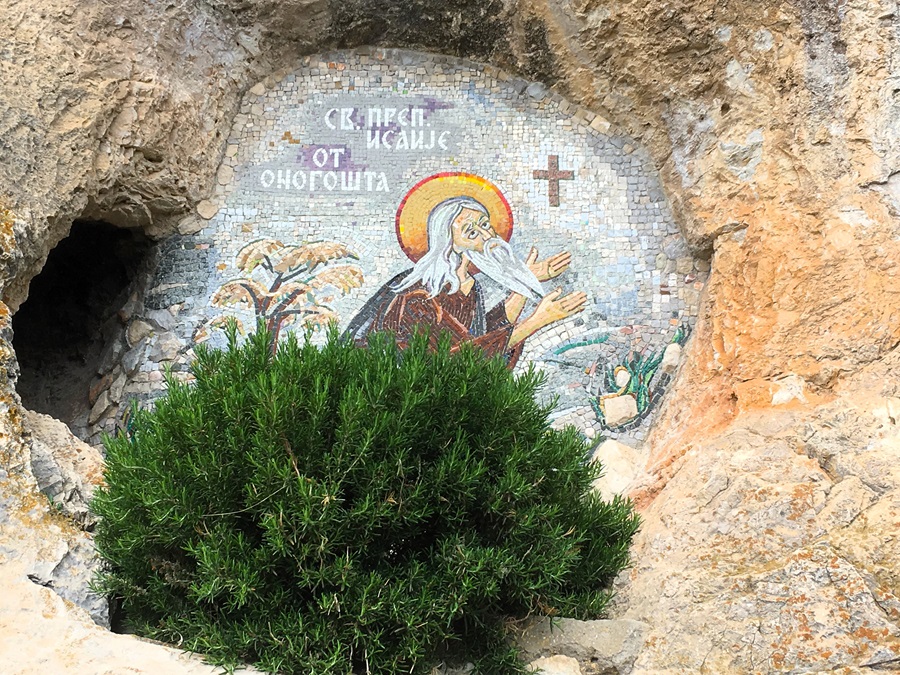
About halfway, large cold drops rained from the heavens. "Where did that come from?" asked Julie. It was clear blue skies all around except for this one lonely dark cloud above us. It was only light rain, and didn't last long. In fact it was actually a welcomed relief. A rosemary bush growing out of the rock was also appreciating the rainfall. A small mosaic image beind the shrub celebrated the fact it was miraculous it was there at all.
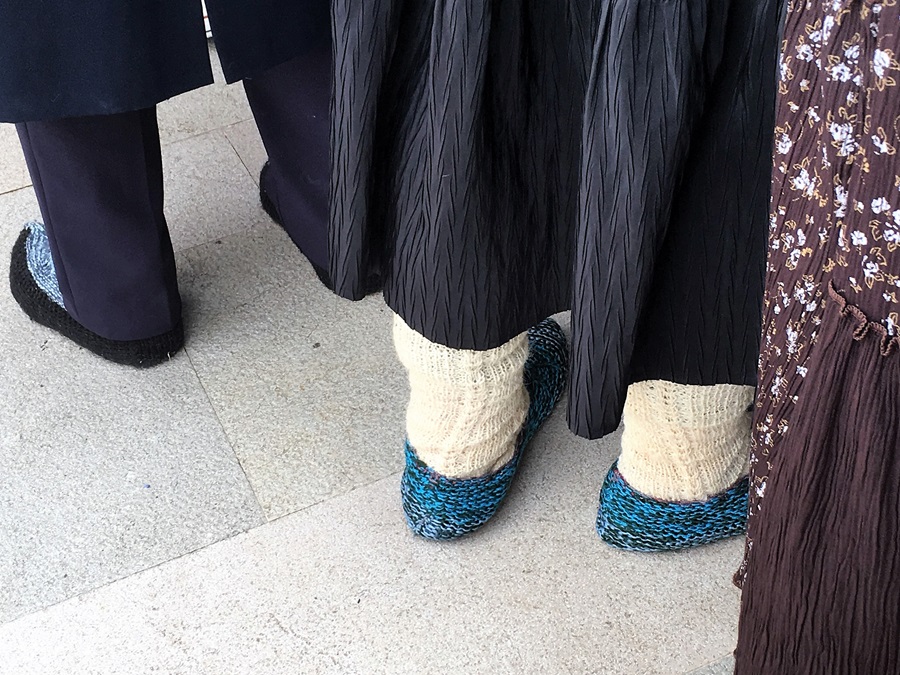
It was really noticeable how local the majority of the people were. A high percentage were grandmothers dressed in black and wearing head scarves. We saw that a few of them weren't wearing any shoes, only a few pairs of woolly socks. Apparently it was traditional for pilgrims to walk the 3km climb from the lower monastery "barefooted" or without shoes at least. Another fascinating tradition we observed was how everyone stopped by the gate on their way out, to either kiss the arch or even the gate itself. And it wasn't only the old superstitious who were doing it, even the youngsters were taking part.
Eventually, after an hour of queuing, we reached the Church of Presentation. The entrance was hardly 4 feet in height. Even Julie had to duck to get inside! It was dark at first as we walked through the first room, with walls covered in vivid orthodox iconographic frescoes. Above the next door there was an area that hadn't been restored. It was faded and difficult to make out but it appeared original and centuries old. That small piece was more special than the rest of the room. We waited to be allowed into the next room. It was a one in one out and they had someone controlling the flow of people. When we entered, we did so together, stepping into a small room, with only enough for five or six people. Sat in the corner a priest was deep in prayer, dispensing blessings. Then, displayed in front of us in a reliquary, a glass coffin, were the remains of St. Basil of Ostrog. It was only in that moment we realised we had come to the holiest pilgrimage site in the entire country. St. Basil, born Vasilije Jovanović, dedicated his life to Christianity, becoming the Bishop of Zahumlje and Herzegovina. He oversaw the founding of the church here. After his death in 1671 his body was buried at Ostrog. He arguably did nothing miraculous, or worthy of sainthood in his lifetime. However in death he became known for his apparitions, appearing in peoples dreams to guide them. The first one noted happened seven years after his death when he appeared to Abbot Kasjerac. The abbot then convinced the church to exhume the remains of St. Basil to find a perfectly preserved body and the smell of basil incence. Since then people have testified of miraculous healings and recoveries after receiving a blessing in the presence of his relics. All of this took us by surprise. We didn't know how to react. Those of us in the room waited our turn to pay our respects. "Just follow what they do" went through my mind, but the lady in front of us lunged forward, virtually kissing the feet of the saint. If only she could. She seemed desperate for a miracle. Then it was our turn. We respectfully bowed our heads, looked solemn and moved on, slightly embarrassed. I dropped a few coins into the collection box and we left the church the way we came in. It had to be one of the strangest experiences we have shared.
We were now walking down the other side of the red cordon to the white washed monastery. Very curious of what was inside we were surprised to see a gift shop! But it is the most visited pilgrimage site in the Balkans. I'm sure it was a great little income generator.
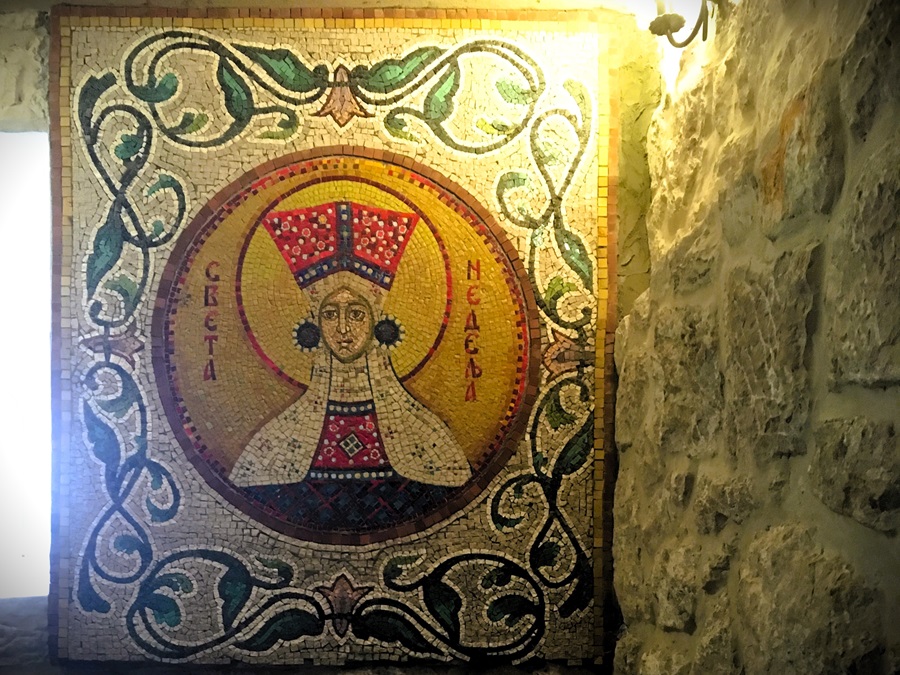
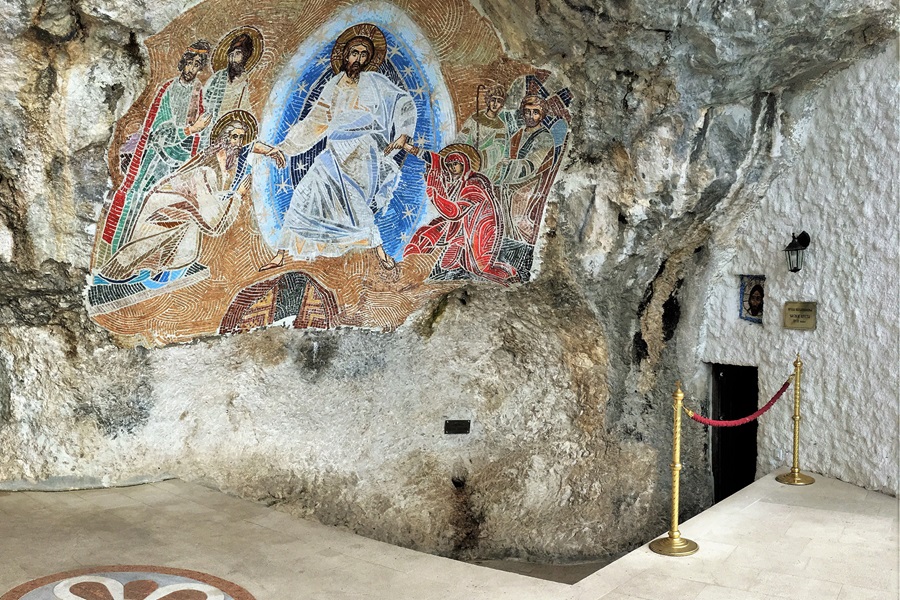
We headed up a floor to see these spectacular mosaics on the surface of the rock. Considering the amount of people who were queuing outside the monastery itself was incredibly quiet. As if it was only the tourist you would find up here.
The mosaics weren't the only thing to see. In the corner was a small door, the entrance to the Church of the Holy Cross. We went inside the small cave, painted floor to ceiling in a dark blue background and golden halos from all the saints. These were also faded and centuries old, which was amazing.
We moved to the balcony from where we could see the lush green Bjelopavlići plains below. It was a stunning view. No wonder St. Basil felt nearer to God here.
Looking directly below us we could see that the queue hadn't reduced at all. There were hundreds of people still waiting to complete their pilgrimage. It as quite a drop down. I read that in 1913 a baby alledgedly fell from the balcony and survived. St Basil was credited with another miracle.
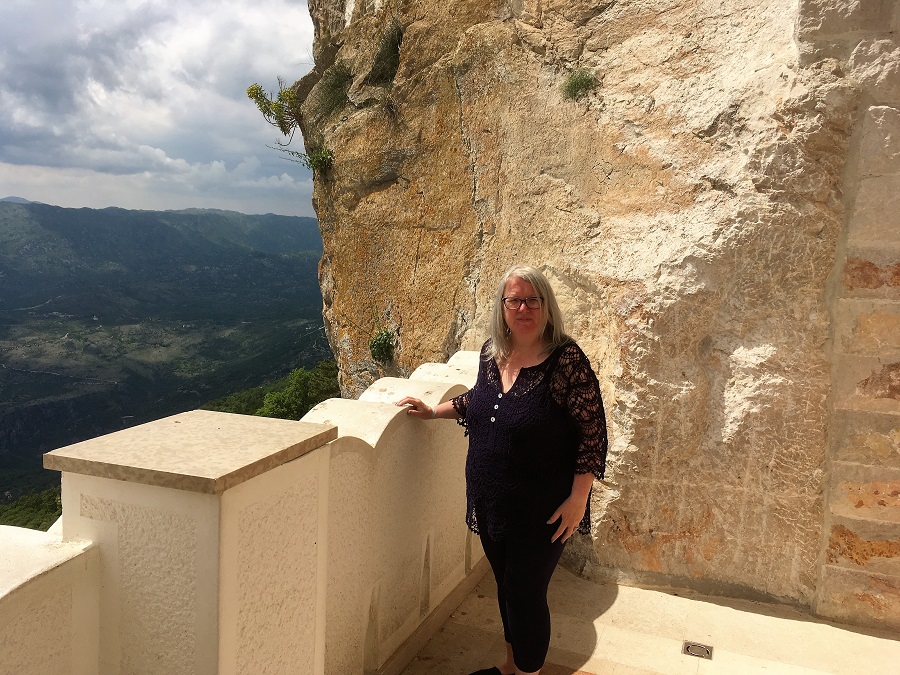
Julie didn't want to rely on miracles to save her if she fell and so she was reluctant to stand by the edge when I asked to take her photo. She did humour me briefly, keeping herself a safe arms length away. Once we had seen all there was to be seen it was time to leave. We returned to the car park, set our SatNav for Sveti Stefan, and set off on another long journey. The drive down the hill was thankfully less eventful. Being on the inside track helped and those cars we did meet pulled over and stopped which made it easier for us. At the bottom of the hill the SatNav was trying to send us back along the narrow road we came along earlier. We agreed to ignore it and turned left, the way the coaches must have arrived.
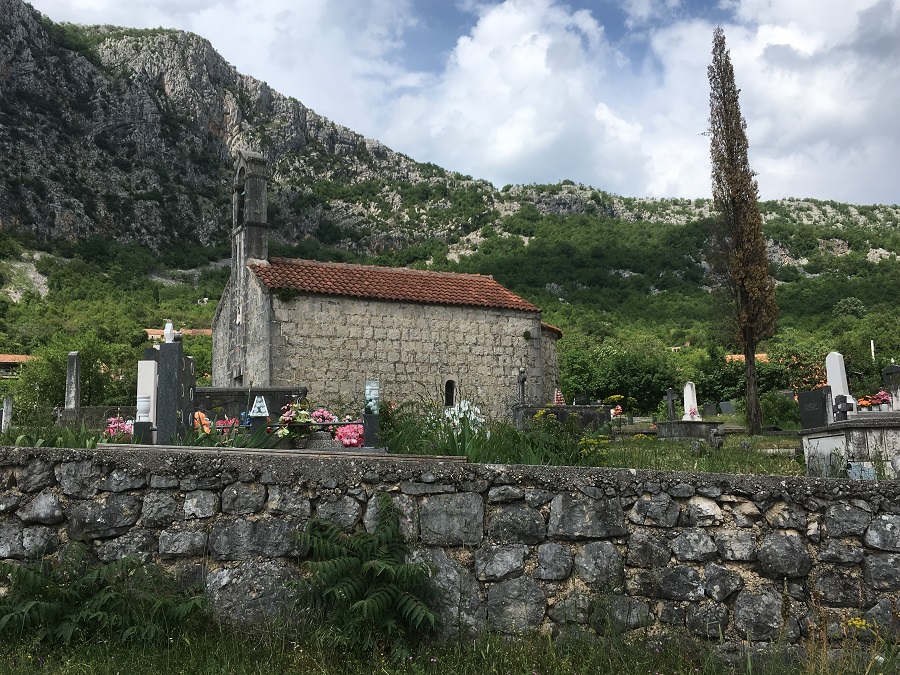
We made good progress along a wide two lane road, reaching in no time the village of Podvraće. A church on a bend in the road caught our attention enough for us to stop and have a closer look. The cemetary was full of flowers.
A mile or so further down the road the SatNav decided to send us off the main road and down a country lane towards Bare Šumanovića. At first it was an acceptable route as we past another church. But then it came so narrow that even our little VW Polo felt too wide. It was still technically a road not a track because it had good tarmac but the hedges were overgrown and we could hear the branches scraping along the side of the shiny new car. Julie was getting increasingly stressed. If we came face to face with another car we would have been in big trouble. But it was too late. It would have been impossible to reverse all the way back. We were temporarily distracted when we saw this beautiful red/brown woodpecker. But then things got worse. At a fork in the road we had a 50/50 choice but the SatNav wasn't showing a fork. After an "ini, mini, miney, mo" we decided to turn downhill. It was soon clear we had made a mistake. The SatNav was showing us in a field somewhere. We had gone off grid in the middle of nowhere! There was only one thing for it. I had to reverse uphill, around the bend, back to the junction. We were so stressed. Back on track, by some miracle we reached the village of Viš, where the road opened up to a comfortable width without meeting a single car. Ten minutes later we reached the town of Danilovgrad where we rejoined the main highway South to the capital Podgorica. We had hoped to have spent a few hours in the city but we decided to push on, skirting around the city, then South past the airport.
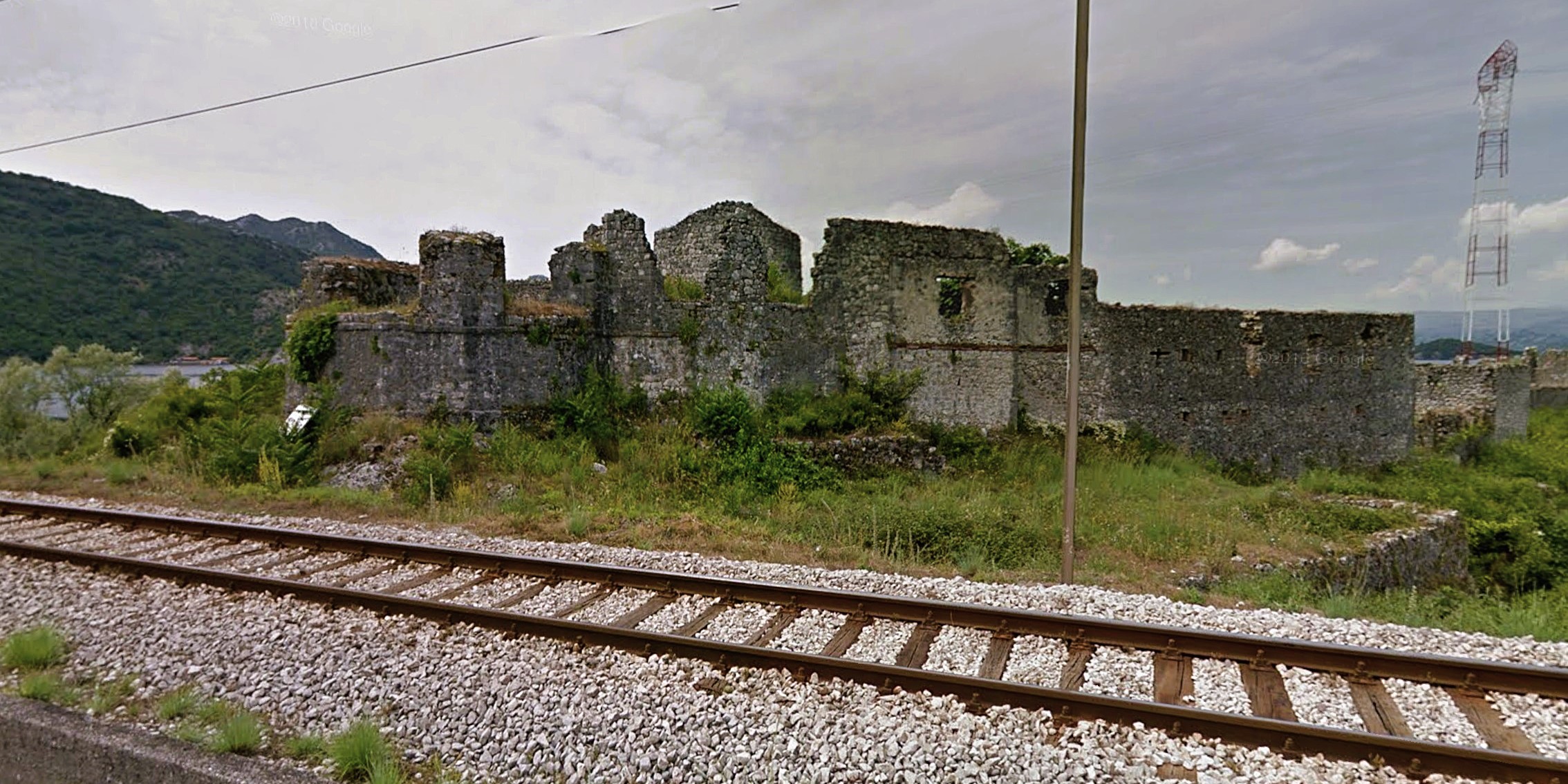
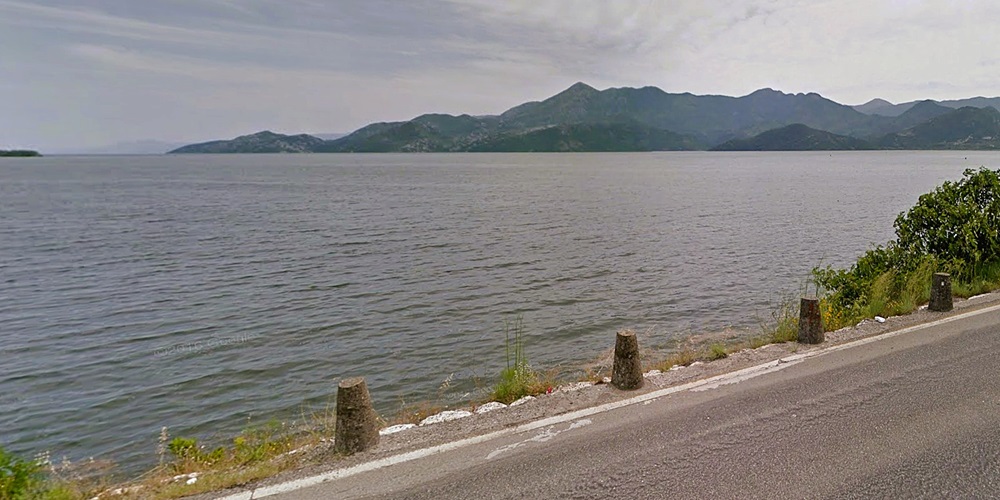
The road took us down to Lake Skadar, the largest lake in the Balkans, shared between Montenegro and Albania. We drove over a causeway built by the Belgrade-Bar Railway Company to cross the lake at the narrowest point. It linked to an island on which the crumbling ruins of the 18th century Fort Lesendro still stood.
The causeway continued beyond the fort, two thirds of the way across the water. Then the final third was completed as two bridges, one rail, one road. When we reached the other side our stomachs suddenly realised, with the exception of a few spoonfuls of "bread porridge" and a packet of crisps, we hadn't eaten all day.
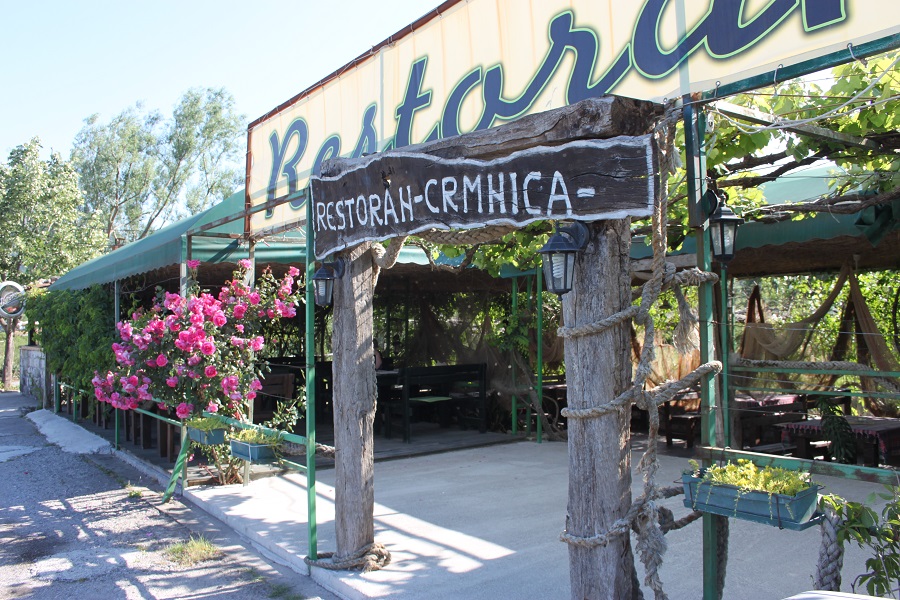
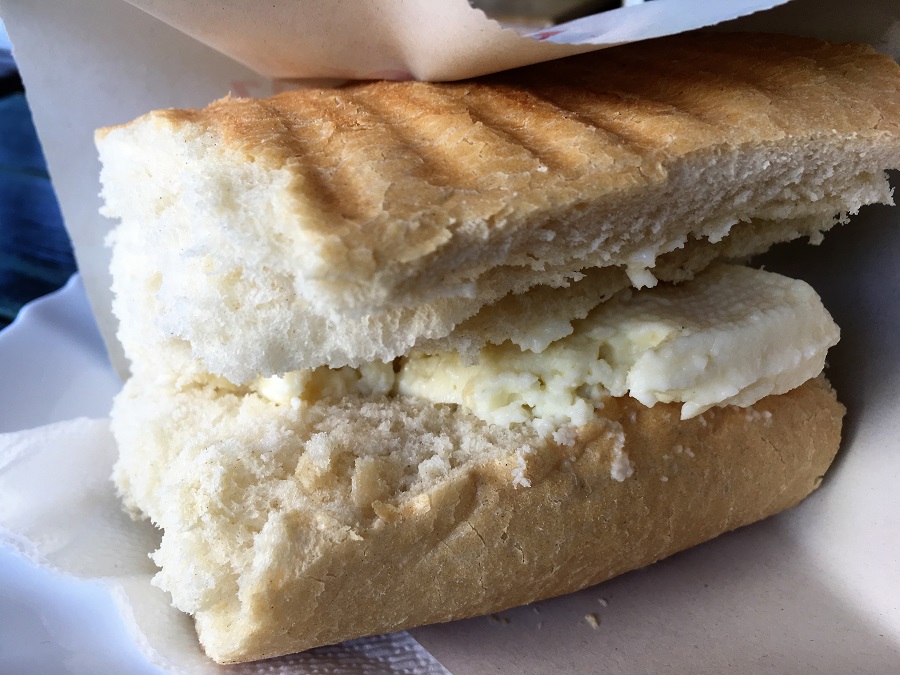
A few minutes later a restaurant appeared by the side of the road called Restoran Crmnica. We walked around but there was no one there. It looked closed. Just as we were about to leave someone appeared from the back. "Zdravo" he said. "Hello" we replied. He came rushing out with menus for us to browse. He was a really friendly buy. It turned out he was an Arsenal fan and we spoke for some time about the future of their manager, Arsene Wenger. Not wanting to ruin our supper tonight we turned to the sandwich choices. I explained this to the waiter. I went for the cheese option. "Good choice, it is fresh made here" he remarked with pride. Julie ordered the chicken sandwich. "Maybe not" he said "it is heavy." suggesting it wasn't the lightest choice. So two sendviči sa sirom were ordered.
When they arrived we laughed out loud. Not only because they were extremely rustic, nothing more than literally a piece of torn baguette, and a slab of cheese. But also they weren't the lighter choice we were expecting, the bread was the size of a small loaf! At least the homemade cheese was tasty and the bread was softer than it looked.
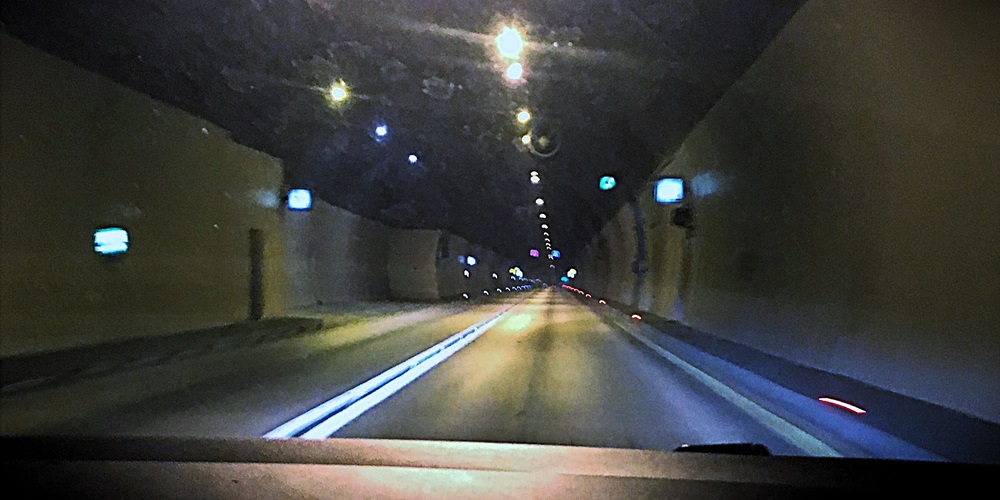
Back on the road we soon came to a toll where we paid €2.50 to use the Sozina tunnel. At over 4km, it was the longest road tunnel in Montenegro. It felt strangely hypnotic driving through this repetitive view, with only the lights giving us a sense of movement. This shortcut through Paštrovska Gora mountain saved us 25km.
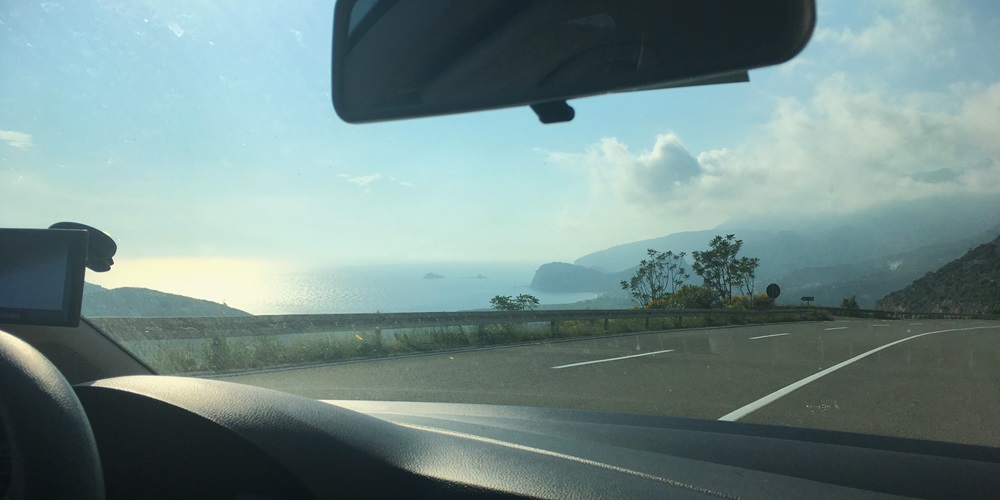
When we finally emerged the other side we were almost at the Adriatic coast. Moments later we could see the sea for the first time. We began to get a little excitable.
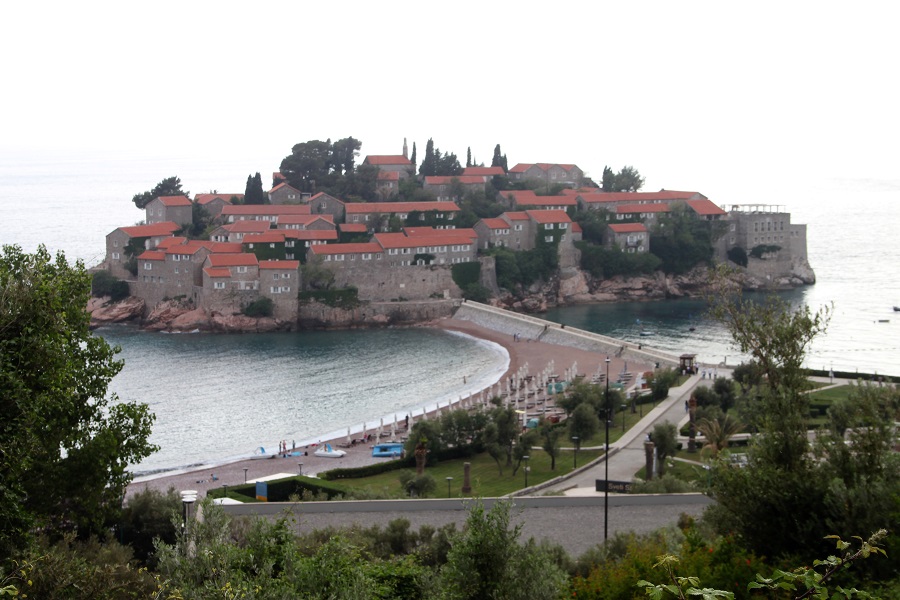
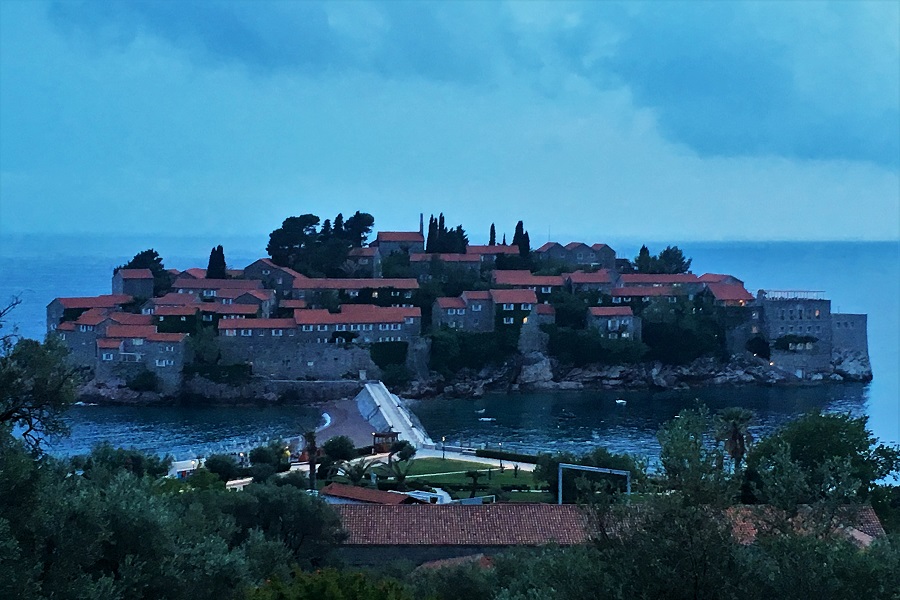
At 6pm we finally arrived in Sveti Stefan, one of Montenegro's picture postcard destinations. The tiny island fishing village connected to the mainland by a short spit was now entirely a 5 star resort, managed by the Aman group. Sadly our budget couldn't stretch to a night there, (starting from £750!) instead we had rented an apartment for the next four nights in the town that grew along the coast. For £25 per night it was great value. We could have stayed there for a month for the cost of one night in the Aman!
We found our accomodation really easily, which was a relief. The owner was busy cleaning the pool when we arrived. He showed us to our one-room with a small self-catering kitchenette in the corner by the door and a balcony. Before doing anything we popped out to find the nearest mini-market. It was literally around the corner and "mini" was an understatement. It was so small we filled it when we walked inside. Despite its small size it was well stocked.
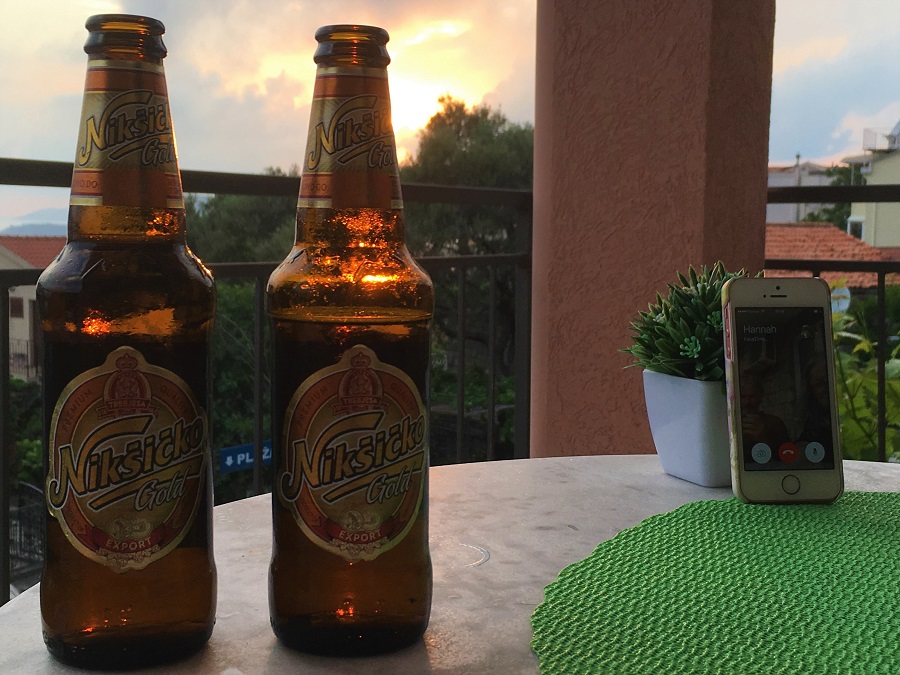
We returned with our supplies and sat out on our balcony sipping some beers whilst the sun set. We instantly felt relaxed. It was a lovely quiet location. There was hardly any passing traffic.
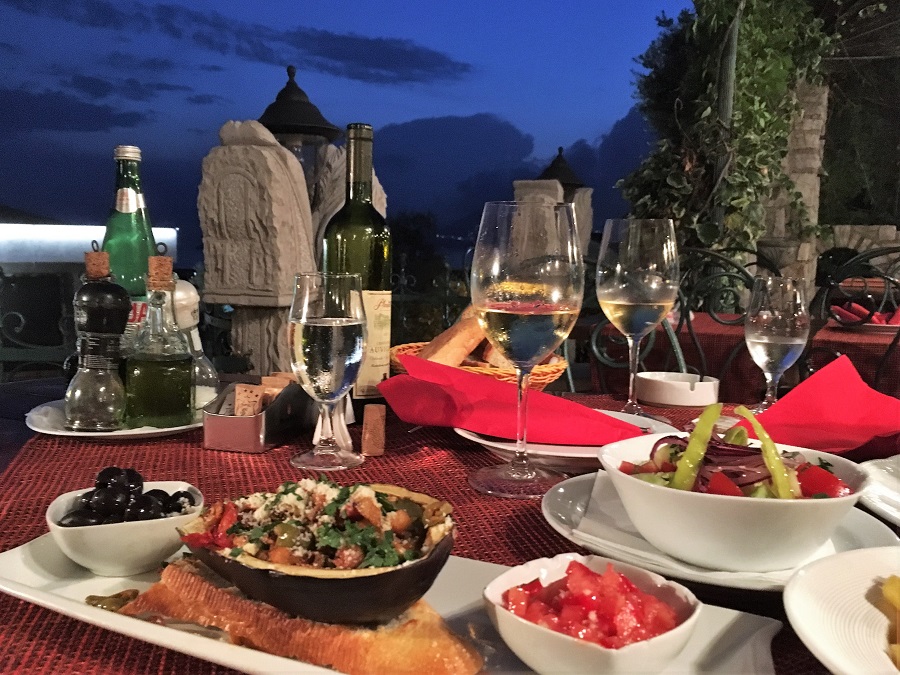
At 8pm we decided to walk down to the beach, but we didn't make it that far. Once we had another good look at the island we turned around and returned to Restaurant Famelja Kentera for our supper.
It had some interesting choices for me on their menu. I ordered a Srpska salata, a Serbian salad made from the usual suspects of tomatoes, cucumbers, red onion but then a large amount of pickled green chillies. When the waiter brought it to the table he warned me it was hot. He wasn't kidding. The chillies were setting my mouth on fire! I had to order another bottle of sparkling water to douse the flames. I also ordered a stuffed aubergine, filled with green and red pepper. To be honest, I couldn't taste a thing, the chillies had robbed me of my sense of taste. Julie ordered the grilled chicken with fries. She didn't like the waiter much. She found him a bit off, chauvinistic even. I think it all began when he poured twice the amount of wine into my glass. And as the evening progressed we didn't see him smile once. We didn't hang around for dessert. Back in our apartment we settled down to watch whatever was on the TV. It turned out to be something like Montenegro's Got Talent. We didn't last long, switching it off before we saw who won. It had been a very long and tiring day. Next Day >>> |
|
©Copyright 2000 - 2026 Colin Owen |